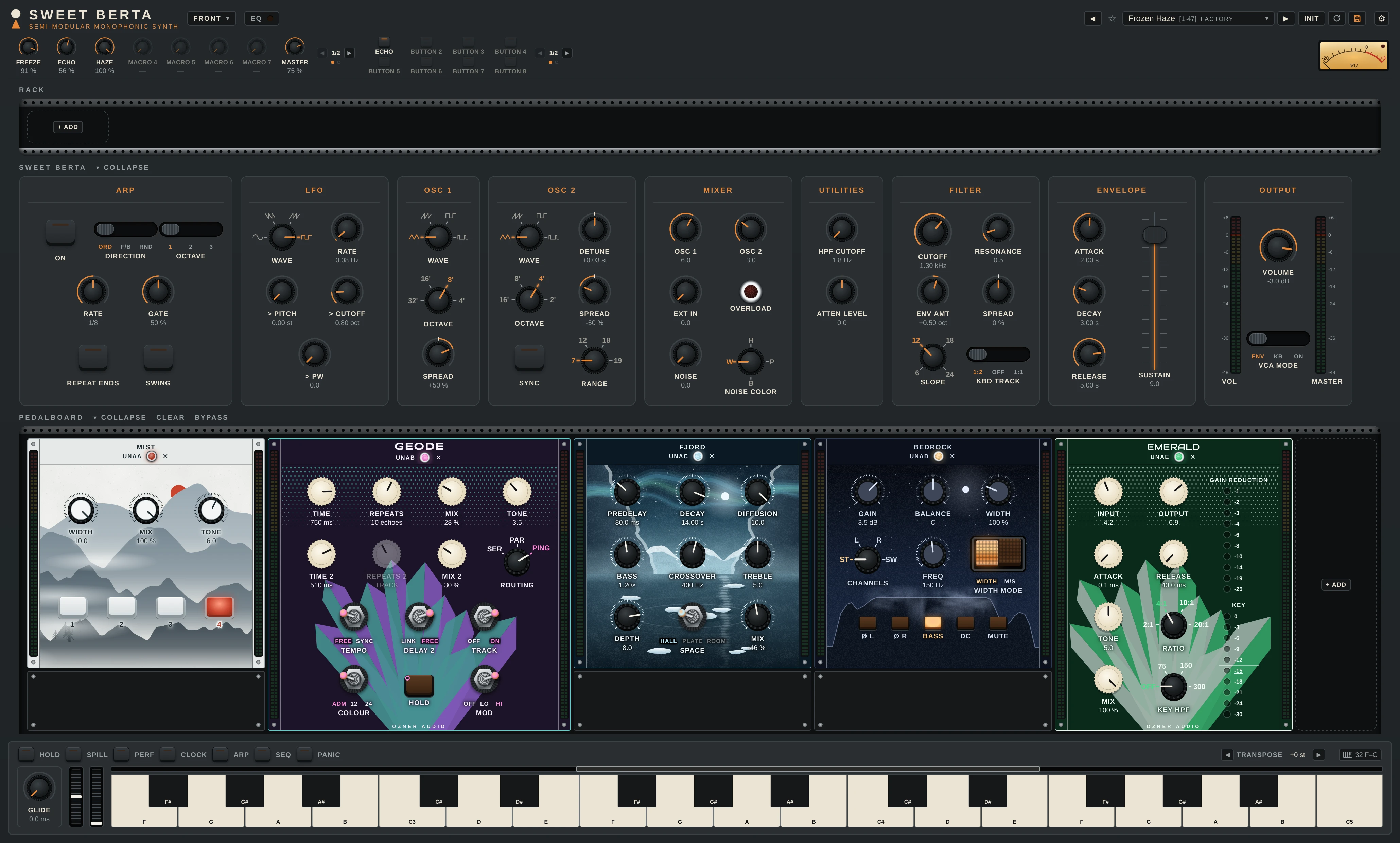
 Hybrid
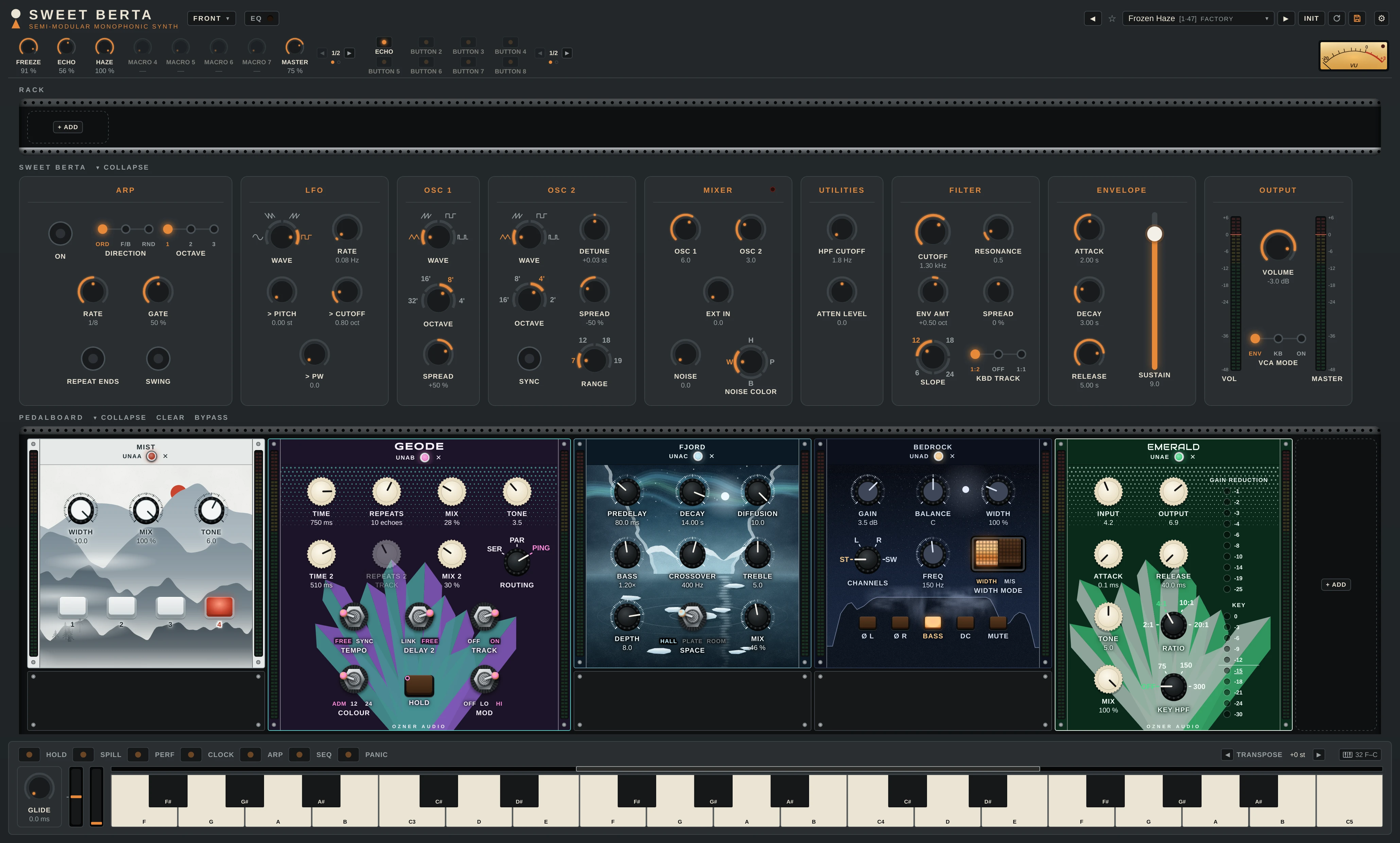 Modern
Every parameter at its default (Macro 8, Master, rests at 0 dB) but the Volume, at -1 dB, and no cables, MAIN OUT through Big Red on the Pedalboard to MASTER IN: two saws a few cents apart into the ladder at 870 Hz, no envelope on the cutoff, the envelope on the VCA. The mod wheel brings in a wobble in the filter. The starting point for a patch from scratch.
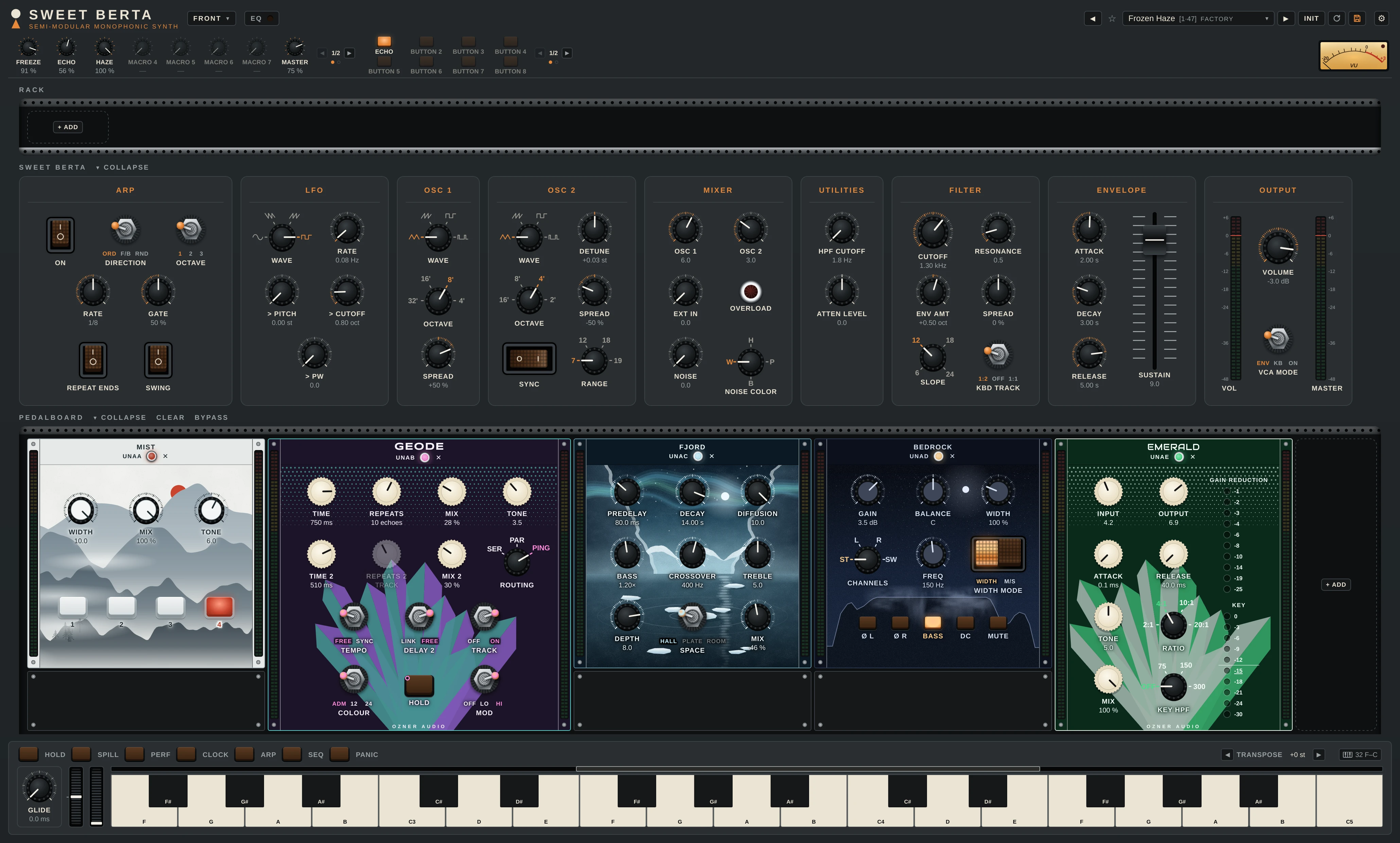
Semi-modular monophonic synth
Sweet Berta
One voice, patched your way. Two oscillators, a ladder filter, a sequencer and an arpeggiator, a patch bay of cables, and a spring reverb.
The launch
Free to claimOpens: November 24, 2026, 12:00 AM UTC. No closing date yet.
Comes with Big Red, unlocked everywhere.
Sweet Berta installs with the Ozner Audio app and a free account. Get the app
AUVST3Standalone
The gallery
Every side of the panel, as the plugin draws it1–24 of 313
The big prog portamento lead: two saws an octave apart that glide on every note, a slow swell, then echoes ping-ponging into a long hall. Play wide leaps slowly and let the glide carry you; add vibrato with the mod wheel on the held notes. Macros: Glide, Dark, Space. Macro 8, Master, is the output level. Button 1, Wet, is a footswitch for the echo and the reverb, lit while they are on; press it to switch both off, and again to bring them back. Button 2, Freeze, is Geode's Hold: the repeats loop what they hold while you play over them, until pressed again. Button 3, Solo, lifts the always-on Crank amp ahead of the pedals: more drive and level for a soft, dark edge in the solo.
A squelching acid line that plays itself: sixteen sixteenths with slides and accents written in, the accented steps biting harder through the filter. Hold a key (C2 plays it as written) and move to other keys to transpose it; ride Cutoff and Squelch. Seq 2 is a busier variation. The mod wheel brings in a wobble in the filter. Macros: Cutoff, Squelch, Decay. Macro 8, Master, is the output level. Button 1, Seq, is a footswitch for the sequencer: drop out to play the line by hand, back in on the next start. Button 2, Busy, switches to sequence 2, which lands on the next bar: the A/B section change by foot. Button 3, Roll, is held: the seq runs twice as fast (1/16 to 1/32), a ratchet fill into the next bar.
A wall of fuzzed haze: detuned saws spread across the speakers into a germanium fuzz, then slow rushing jets, a deep chorus and a huge hall, so every note blurs into a roaring wash. Hold long notes and move slowly; octaves make the wall bigger. The mod wheel brings in a slow sweep of the filter. Macros: Fuzz, Wash, Bright, Res, Jets, Swirl, Volume. Macro 8, Master, is the output level. Volume pushes the voice into the fuzz: turn it down to clean the fuzz up. Button 1, Melt, is a switch: the tub surges, the chorus goes all the way wet with all four of its buttons in, and the wall melts, until pressed again, then the wall comes back. Button 2, Chorus, is a footswitch for the chorus: dry and centred when off. Button 3, Wash, is held: the reverb rings 20 s instead of 7 s, a reverb throw on the last note or chord.
The big-room pluck: two wide saws an octave apart, snapped shut with a little resonance, echoing in clean dotted eighths on the song's tempo and spread by a deep chorus. Play bright off-beat single notes and rolling sixteenth runs by hand. The mod wheel brings in a wobble in the filter. Macros: Bright, Echo, Chorus, Decay, Arp Rate (1/4 to 1/32, resting on dotted eighths). Macro 8, Master, is the output level. Button 1, Echo, is a footswitch for the echo: off, the repeats ring out (Spillover) and the line goes dry. Button 2, Freeze, is Geode's Hold: the repeats loop what they hold while you play over them, until pressed again. Button 3, Wash, is held: the reverb rings 8 s instead of 1.8 s, a reverb throw on the last note or chord. Button 4, Arp, is a footswitch for the arpeggiator: hold a chord and it runs in dotted eighths with the echo.
The wobble bass, in time with the song: an Undertow in the Rack does nothing but swing, its LFO jack on the cutoff in eighth notes from the host's tempo, into a dark, driven amp. The Pedalboard splits it at 120 Hz, so the amp drives only the wobble above and the sub under it stays clean and steady. Hold long notes and let the beat do the work. The mod wheel brings in a gentle vibrato. Macros: Cutoff, Res, Depth. Macro 8, Master, is the output level. Button 1, Drive, brings in the amp on the high band: it loads off, so the wobble starts clean; press it for the grind, and again to take it out. Button 2, Sub, drops osc 1 an octave (16' to 32') under osc 2: the drop section's weight. Button 3, Slide, sets the glide from 0 s to 0.12 s on overlapping notes only: slides on demand.
The hypnotic seventies sequencer sound: a resonant saw and square running sixteenths over two octaves, the filter rising and falling on a very slow tide while the notes repeat, a dotted echo filling the gaps. Hold a minor chord for minutes and let the filter move. An Emerald shaves the spike of each note, so the body sits louder. The mod wheel brings in a gentle vibrato. Macros: Cutoff, Res, Tide, Echo. Macro 8, Master, is the output level. Button 1, Wet, is a footswitch for the echo and the reverb, lit while they are on; press it to switch both off, and again to bring them back. Button 2, Arp, is a footswitch for the arpeggiator: stop the pattern and let the held note ring, start it again on the next bar. Button 3, Climb, stretches the arpeggio from 2 to 3 octaves for the build. Button 4, Roll, is held: the arp runs twice as fast (1/16 to 1/32), a ratchet fill into the next bar.
Every key kicks the spring tank: the gate patched into a second Big Red's Kick, so each new note boings the springs, shaking up what the last one left ringing. Play short square plucks in a steady rhythm for a clanging, rattling bed; leave gaps for quieter boings. The mod wheel brings in a wobble in the filter. Macros: Spring, Pluck, Bright. Macro 8, Master, is the output level. Button 1, Ring, makes notes ring on after the key, so each new key boings a tank that is still full. Button 2, Spring, is a footswitch for the tank: dry square plucks when off, the tail spilling out.
A soaring saw lead flanged by Jacuzza's jets, a deep rush climbing and falling under every note. Take-Off does nothing until halfway, then holds Surge: the swirl speeds up and the jets deepen over a second and a half, then settle when it comes back down. Learn it to the mod wheel and pull it up for the take-off. The mod wheel brings in a vibrato. Macros: Take-Off, Jets, Swirl, Dark, Glide, Space. Macro 8, Master, is the output level. Button 1, Solo, lifts the always-on Crank amp ahead of the pedals: more drive and level for a rousing crunch in the solo. Button 2, Surge, is a switch: the tub opens up (swirl faster, jets deeper) until pressed again, then settles. Button 3, Wash, is held: the reverb rings 8 s instead of 2.2 s, a reverb throw on the last note or chord.
A bell-toned electric piano: osc 1 frequency-modulates osc 2 at the same pitch for the struck tine, the filter closing as each note fades, the sides swaying in a slow stereo tremolo. Play soft, jazzy lines and let each note ring; harder notes bark. The mod wheel brings in a wobble in the filter. Macros: Bark, Sway, Ring, Space. Macro 8, Master, is the output level. Button 1, Fast, makes the swing four times faster (3.6 to 14.4 Hz): the slow/fast switch of a rotary or a tremolo. Button 2, Wash, is held: the reverb rings 8 s instead of 1.1 s, a reverb throw on the last note or chord.
The warehouse-techno kick: a punchy kick played dry, with a dark hall behind it thickened and filtered down to a low, rolling rumble that fills the gap to the next hit. Patched in parallel through the Rack: Main Out goes straight to Master In, and Euro Out, the voice before the Volume, through a wet hall and a dark amp beside it. Play straight quarter notes at C2 to C3. The mod wheel brings in a wobble in the filter. Macros: Length, Punch. Macro 8, Master, is the output level. Button 1, Click, is held: the kick opens to a harder knock for accents and fills (the rumble path follows, it is fed by the same voice).
The classic two-saw mono bass: both oscillators at 16', slightly apart, warming the mixer, into the 24 dB ladder with a firm envelope, then a warm saturation. The one to reach for first; plays anything from roots to busy lines. The mod wheel brings in a wobble in the filter. Macros: Cutoff, Emphasis, Decay. Macro 8, Master, is the output level. Button 1, Slide, sets the glide from 0 s to 0.12 s on overlapping notes only: slides on demand.
A wordless choir: a saw and a narrow pulse an octave up through the HPF into a resonant ladder, a band like a sung vowel, with a soft vibrato always on and a deep chorus. Play slow melodies or long notes; Vowel moves the band from 'oo' toward 'ah'. The mod wheel opens a wobble in the vowel. Macros: Vowel, Thin, Space. Macro 8, Master, is the output level. Button 1, Chorus, is a footswitch for the chorus: dry and centred when off. Button 2, Wash, is held: the reverb rings 12 s instead of 4 s, a reverb throw on the last note or chord.
A saw over a square sub with EURO OUT patched back into the mixer's EXT IN: the voice feeds on itself, so held notes thicken and start to howl like an amp turned toward its speaker. Play long, held notes and let the howl build; Howl turns the feedback up. The mod wheel brings in the vibrato. Macros: Howl, Bright, Space. Macro 8, Master, is the output level. Button 1, Slide, sets the glide from 0.03 s to 0.25 s on overlapping notes only: slides on demand. Button 2, Kill, is held: the voice drops out (the pedals' tails ring on), a kill-switch stutter. Button 3, Wash, is held: the reverb rings 8 s instead of 0.9 s, a reverb throw on the last note or chord.
A driving rock gallop, an eighth and two sixteenths on every beat, two saws growling through the amp, ahead of the filter, with the low end filled back in. Hold E1 or E2 to run it as written, and shift keys for the changes; it pairs with a straight kick. The mod wheel brings in a wobble in the filter. Macros: Cutoff, Res, Tone, Low End, Gate. Macro 8, Master, is the output level. Button 1, Seq, is a footswitch for the sequencer: drop out to play the line by hand, back in on the next start. Button 2, Climb, switches to sequence 2, which lands on the next bar: the A/B section change by foot. Button 3, Roll, is held: the seq runs twice as fast (1/16 to 1/32), a ratchet fill into the next bar. Button 4, Sub, drops osc 1 an octave (16' to 32') under osc 2: the drop section's weight.
A bright, singing steel drum: a triangle struck by osc 1 at three times its pitch, so the octave and the twelfth bloom out of every hit and fade into a round hum, with a quick wobble on the strike. Play bouncy calypso melodies and quick rolls in the middle of the keyboard; harder hits ring brighter. The mod wheel brings in a wobble in the filter. Macros: Ring, Shine, Roll, Space. Macro 8, Master, is the output level. Button 1, Fast, makes the swing four times faster (7.5 to 15 Hz): the slow/fast switch of a rotary or a tremolo. Button 2, Wash, is held: the reverb rings 8 s instead of 1.4 s, a reverb throw on the last note or chord.
A small robot talking to itself: the sample and hold throws both oscillators and a resonant ladder to a new random place eleven times a second, so a held note babbles in blips and vowels, scattered into ping-pong echoes. Hold a note to make it talk; a higher key raises its voice. The mod wheel brings in a shimmer in the pulse width. Macros: Speed, Range, Echo. Macro 8, Master, is the output level. Button 1, Echo, is a footswitch for the echo: off, the repeats ring out (Spillover) and the line goes dry. Button 2, Freeze, is Geode's Hold: the repeats loop what they hold while you play over them, until pressed again. Button 3, Wash, is held: the reverb rings 8 s instead of 1.5 s, a reverb throw on the last note or chord.
A warm, overdriven glow: detuned saws through an amp in the Rack before the filter, so the grit is shaped by the ladder into a dark, amber growl that swells in and sways slowly. Hold long notes in the low middle; Cutoff opens the glow. The mod wheel brings in a gentle vibrato. Macros: Cutoff, Space. Macro 8, Master, is the output level. Button 1, Chorus, is a footswitch for the chorus: dry and centred when off. Button 2, Wash, is held: the reverb rings 15 s instead of 5 s, a reverb throw on the last note or chord.
A talking growl: the mixer runs through the amp and the HPF into the ladder, a band-pass that the LFO swings open and shut, fast at the start of each note and slowing as the envelope falls, like a mouth yawning. Hold notes of a beat or two. The mod wheel brings in a gentle vibrato. Macros: Rate, Mouth, Cutoff, Res. Macro 8, Master, is the output level. Button 1, Sub, drops osc 1 an octave (16' to 32') under osc 2: the drop section's weight. Button 2, Slide, sets the glide from 0 s to 0.12 s on overlapping notes only: slides on demand. Button 3, Dark, flips the amp's Voice to Dark: woollier, a doom wall (a bypass would drop the line by the amp's Level).
Glassy FM bells tumbling up three octaves in sixteenths: a triangle ringing another a little off its octave, struck and dying away, with a ping-pong echo and a hall around them. Hold a wide chord and let it sparkle; change chords slowly. The mod wheel brings in a wobble in the filter. Macros: Shine, Decay, Echo, Space, Rate (the arpeggiator's whole run of step lengths, slowest to fastest, resting at sixteenths on the host's tempo). Macro 8, Master, is the output level. Button 1, Arp, is a footswitch for the arpeggiator: stop the pattern and let the held note ring, start it again on the next bar. Button 2, Freeze, is Geode's Hold: the repeats loop what they hold while you play over them, until pressed again. Button 3, Echo, is a footswitch for the echo: off, the repeats ring out (Spillover) and the line goes dry.
A hard-sync lead played by touch: velocity sets how high the synced osc 2 sits, and a short envelope snaps it down on every note. Play soft for a round tone and dig in for a bright tear. Macros: Bright, Decay, Space. Macro 8, Master, is the output level. Button 1, Sync, is a footswitch for hard sync: let go for the plain interval, press back for the tear. Button 2, Slide, sets the glide from 0.03 s to 0.25 s on overlapping notes only: slides on demand. Button 3, Wash, is held: the reverb rings 8 s instead of 1 s, a reverb throw on the last note or chord.
One strike of lightning and the thunder after it: white noise cracks open through the ladder and rolls down into darkness. The Pedalboard splits it at 200 Hz: the gate kicks a set of springs on the band above for the crack, while a sub swells under the band below for the rumble, all into a long, dark hall. Tap a low note, once, and let it roll. The mod wheel brings in a wobble in the filter. Macros: Crack, Rumble, Space. Macro 8, Master, is the output level. Button 1, Wash, is held: the reverb rings 20 s instead of 7 s, a reverb throw on the last note or chord.
A bright, quacking clav: two narrow pulses through a resonant envelope snap, the lows trimmed by the high-pass filter and squeezed even. Play tight sixteenth-note rhythm parts and lift off quickly; dig in for more quack. The mod wheel brings in a wobble in the filter. Macros: Quack, Thin, Cutoff, Decay. Macro 8, Master, is the output level. Button 1, Dirt, brings in Zest's grit for a harder section.
Two saws a fifth of a semitone apart, the dark drum-and-bass Reese: the Pedalboard splits it at 140 Hz, so the low band stays clean and centred while the band above is saturated bright and spread wide by a chorus. Big on headphones, solid on a club system. Hold long notes and let the beating roll. The mod wheel brings in a wobble in the filter. Macros: Cutoff, Chorus. Macro 8, Master, is the output level. Button 1, Sub, drops osc 1 an octave (16' to 32') under osc 2: the drop section's weight. Button 2, Slide, sets the glide from 0 s to 0.12 s on overlapping notes only: slides on demand.
Changelog
A semi-modular monophonic synth with a patch bay that plays with no cable in it, an arpeggiator and a sequencer locked to your DAW, and its own effects.
New
Play a semi-modular monophonic synth
Two oscillators, noise with a colour selector and an external input feed a mixer, a ladder filter, an envelope, an amplifier and an LFO. The patch bay over it lets you reroute all of it, and it plays with no cable in it. Play it from MIDI, the on-screen keyboard or your computer keys.
Run an arpeggiator locked to your DAW
It plays the keys you hold one at a time, in order, forward and back or at random, over one to three octaves. Steps run from whole notes down to 64th-note triplets, on the DAW's grid, and HOLD keeps the pattern going when you let go.
Write sequences of up to 256 steps
Three sequences, each step a note or a rest, tied to the one before and accented as you like. A key starts a sequence and transposes it, and you can switch sequences from MIDI at the next bar, at the sequence's end or at once.
Add effects as pedals or as modules
Its effects are pedals on one Pedalboard, from board in to board out, or units in the Rack that you patch as modules. Big Red's spring reverb comes with it, unlocked everywhere, and an eight-band EQ sits over the instrument.
Turn sixteen macros for a whole sound
Every sound has sixteen macro knobs and sixteen buttons. A preset names them and points each at the knobs that matter, so a controller you map once follows every preset you load. A button that switches an effect or the arpeggiator is a footswitch: it loads lit, and pressing it switches the thing off.
Bring any sound to life with the mod wheel
The LFO's > Cutoff starts at 0.8 octaves, so the mod wheel wobbles the filter on every sound that has no other job for it, and each sound's description says what the wheel does. The wheel at rest changes nothing.
Keep your level through every sound with Master
Macro 8 is Master: the plugin's output level, from -60 to +6 dB and resting at 0 dB, after the effects and the EQ. It is the plugin's own, so loading a sound leaves it where you put it, and your project saves it. Your DAW can automate it, and a MIDI controller can turn it.
Change sounds without cutting a note
There are 313 factory presets, and you can save your own with a name, tags and an author. Loading one never cuts a held note or a tail.
Reach your own presets from a MIDI controller
Your presets are programs from bank 11 up, each with a number fixed when you save it, counted from 1 as your DAW shows it: bank 11, program 1 loads the first. The browser shows the number and lets you renumber it, and your DAW's program list names them, so a setlist or a controller reaches your sounds as it reaches the factory ones.
Key a pedal from another signal
A pedal's own inputs past In, Emerald's Sidechain In, now show on the Pedalboard's back, so External In or any other jack can drive its squeeze.
Run other audio through the voice
Send another track to Sweet Berta's sidechain input and raise Ext In to run it through the mixer, filter and amplifier. A stereo input stays stereo.
Choose a look and a format
Three looks, Hardware, Hybrid and Modern, change only how the panel looks, never the sound. It runs as AU, VST3 and a standalone app.
Use the Option shortcuts in your DAW too
Option+P, Option+C and Option+A open the pop-ups, and Option+F, B, S, O and E go to a side. Option+Shift+A, S, E and N toggle the arp, the sequencer, the EQ and the patch bay's Normals, and Option+K, H and X toggle Computer Keys and Hold and panic. They work while Sweet Berta's window has focus (Alt on Windows and Linux).