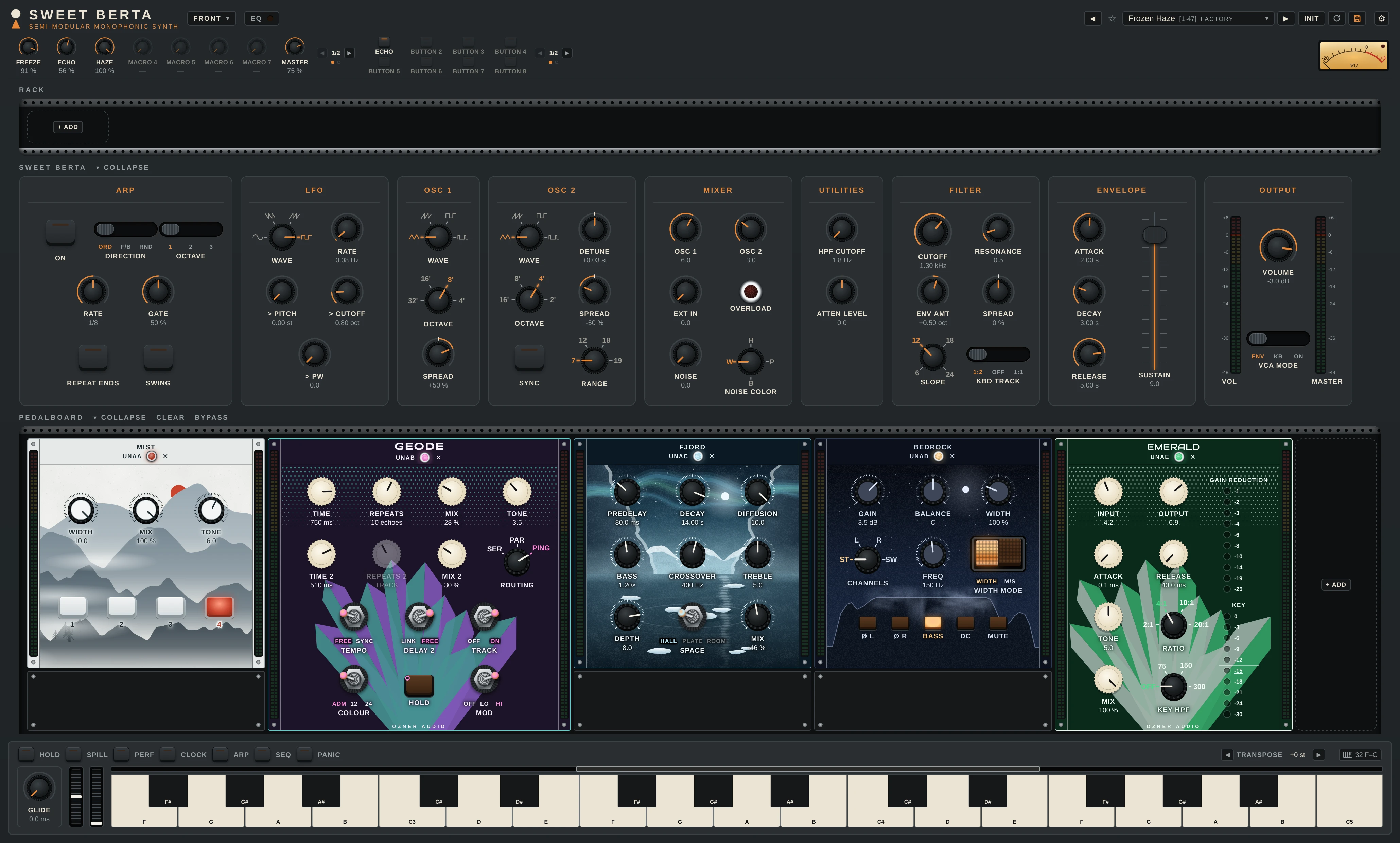
 Hybrid
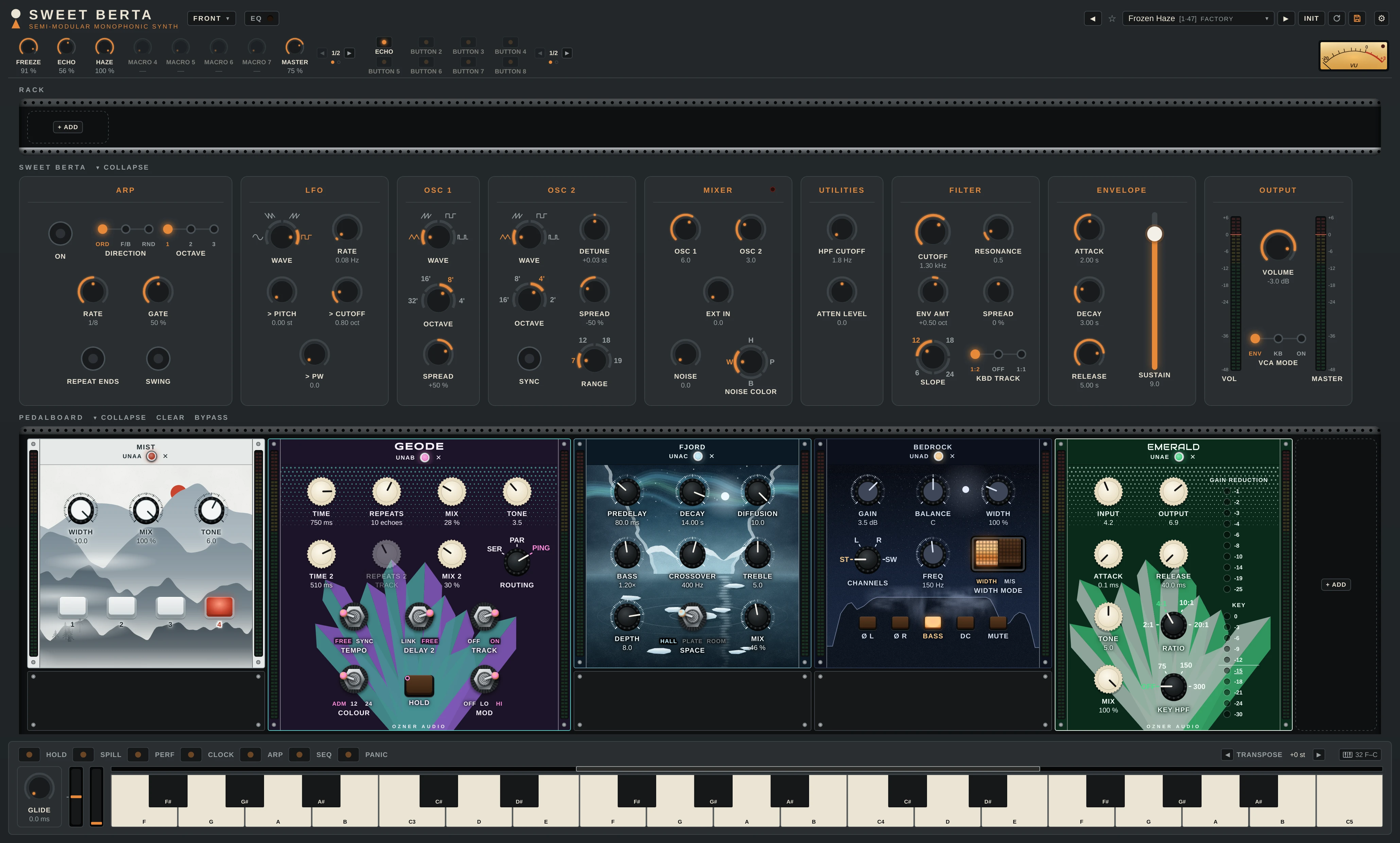 Modern
A round, rolling bass in eighth-note triplets, up and back down through the notes you hold: a triangle with a quiet square under it, warm and deep, with a sub added below. Hold a root, its fifth and its octave over a straight beat and let the triplets roll against it. The mod wheel brings in a wobble in the filter. Macros: Cutoff, Sub, Decay, Gate. Macro 8, Master, is the output level. Button 1, Arp, is a footswitch for the arpeggiator: stop the pattern and let the held note ring, start it again on the next bar. Button 2, Roll, is held: the arp runs twice as fast (1/8T to 1/16T), a ratchet fill into the next bar. Button 3, Sub, drops osc 1 an octave (16' to 32') under osc 2: the drop section's weight.
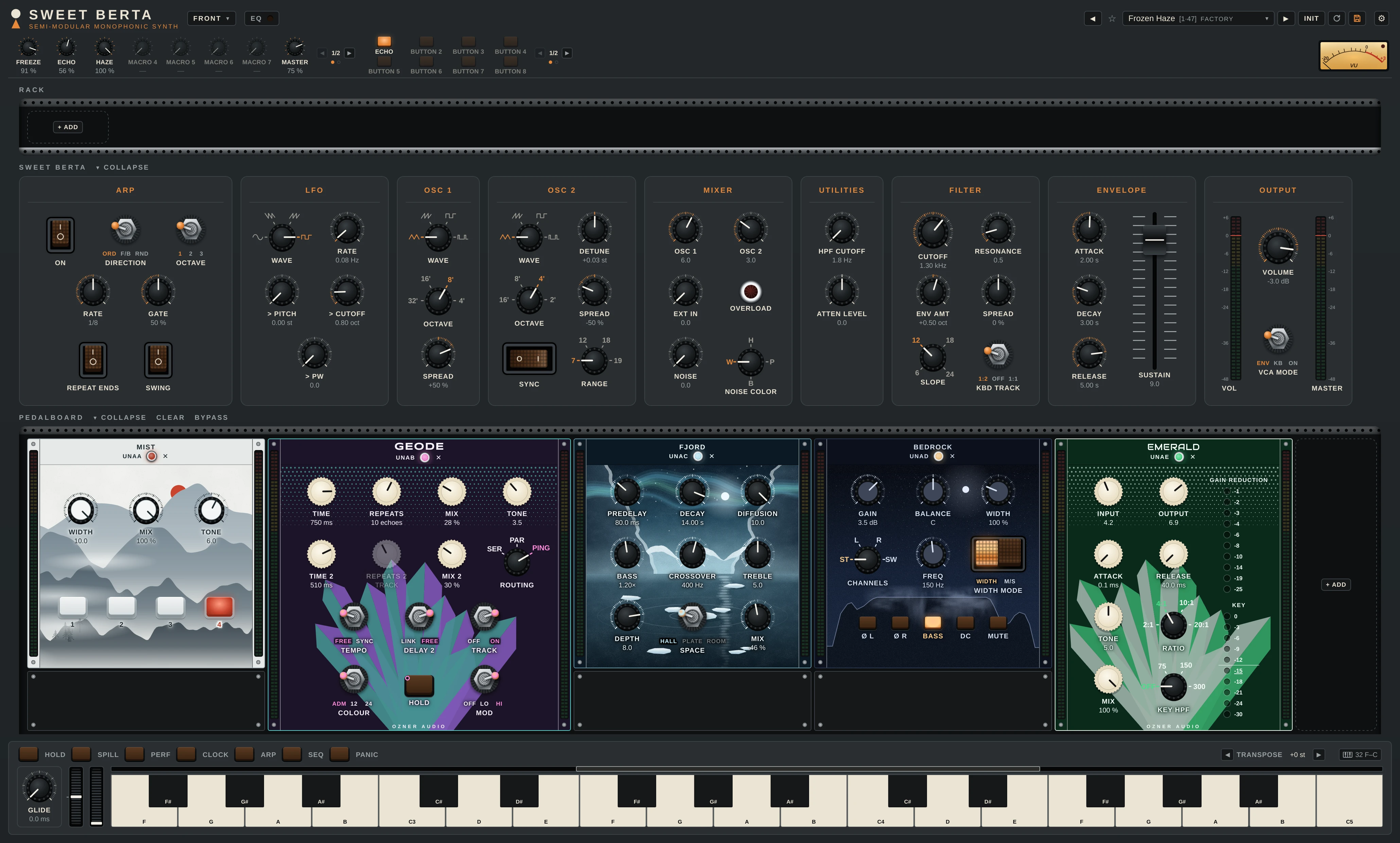
Semi-modular monophonic synth
Sweet Berta
One voice, patched your way. Two oscillators, a ladder filter, a sequencer and an arpeggiator, a patch bay of cables, and a spring reverb.
The launch
Free to claimOpens: November 24, 2026, 12:00 AM UTC. No closing date yet.
Comes with Big Red, unlocked everywhere.
Sweet Berta installs with the Ozner Audio app and a free account. Get the app
AUVST3Standalone
The gallery
Every side of the panel, as the plugin draws it265–288 of 313
A springy, metallic bass: osc 1's square modulates a triangle an octave above it, so each step clanks and then settles, bouncing up and down two octaves in swung sixteenths. Hold two or three low notes for a funky, rubbery figure. The mod wheel brings in a wobble in the filter. Macros: Clank, Cutoff, Decay, Swing. Macro 8, Master, is the output level. Button 1, Arp, is a footswitch for the arpeggiator: stop the pattern and let the held note ring, start it again on the next bar. Button 2, Climb, stretches the arpeggio from 2 to 3 octaves for the build. Button 3, Roll, is held: the arp runs twice as fast (1/16 to 1/32), a ratchet fill into the next bar.
A bright, tearing arpeggio climbing three octaves in sixteenths: osc 2 hard-synced to osc 1, a slow LFO sweeping its tone so the pattern keeps changing colour, with a ping-pong echo in dotted eighths. Hold a triad high up and ride the mod wheel for vibrato. Macros: Sweep, Cutoff, Echo, Gate. Macro 8, Master, is the output level. Button 1, Arp, is a footswitch for the arpeggiator: stop the pattern and let the held note ring, start it again on the next bar. Button 2, Roll, is held: the arp runs twice as fast (1/16 to 1/32), a ratchet fill into the next bar. Button 3, Sync, is a footswitch for hard sync: let go for the plain interval, press back for the tear.
The handheld-game chord: a thin pulse running through whatever you hold in thirty-second notes, so a held triad shimmers into one buzzing chord. Hold triads and change them on the beat; the mod wheel adds a game-style vibrato. Macros: Chop, Tone, Echo. Macro 8, Master, is the output level. Button 1, Arp, is a footswitch for the arpeggiator: stop the pattern and let the held note ring, start it again on the next bar. Button 2, Roll, is held: the arp runs twice as fast (1/32 to 1/64), a ratchet fill into the next bar.
A soaring lead that spirals: two saws a fifth apart, each step gliding into the next in eighth-note triplets, up two octaves and back down, through a chorus, a long echo and a hall. Hold two or three notes and let it sing; the mod wheel brings in vibrato. Macros: Glide, Dark, Space. Macro 8, Master, is the output level. Button 1, Arp, is a footswitch for the arpeggiator: stop the pattern and let the held note ring, start it again on the next bar. Button 2, Roll, is held: the arp runs twice as fast (1/8T to 1/16T), a ratchet fill into the next bar. Button 3, Solo, lifts the always-on Crank amp ahead of the pedals: more drive and level for a clear crunch in the solo.
Wind chimes on the beat: two high triangles struck in a random order over three octaves of what you hold, in eighth notes, with a long echo and a big hall. Hold a pentatonic cluster and leave it; no two bars are alike. The mod wheel brings in a wobble in the filter. Macros: Ring, Bright, Echo, Space. Macro 8, Master, is the output level. Button 1, Arp, is a footswitch for the arpeggiator: stop the pattern and let the held note ring, start it again on the next bar. Button 2, Roll, is held: the arp runs twice as fast (1/8 to 1/16), a ratchet fill into the next bar. Button 3, Echo, is a footswitch for the echo: off, the repeats ring out (Spillover) and the line goes dry. Button 4, Freeze, is Geode's Hold: the repeats loop what they hold while you play over them, until pressed again.
A swung house-piano figure: a square and a saw an octave up, short and plucky, running sixteenths through the chord you hold with a strong shuffle and a chorus. Hold minor sevenths and ninths, one a bar. The mod wheel brings in a wobble in the filter. Macros: Cutoff, Swing, Decay, Chorus. Macro 8, Master, is the output level. Button 1, Arp, is a footswitch for the arpeggiator: stop the pattern and let the held note ring, start it again on the next bar. Button 2, Climb, stretches the arpeggio from 1 to 2 octaves for the build. Button 3, Roll, is held: the arp runs twice as fast (1/16 to 1/32), a ratchet fill into the next bar. Button 4, Wash, is held: the reverb rings 8 s instead of 0.8 s, a reverb throw on the last note or chord.
A harp's glissando under your hand: a plucked triangle and a thin pulse sweeping up three octaves of the chord you hold in thirty-second notes, ringing into a hall. Tap a chord for one sweep, hold it for a cascade. The mod wheel brings in a wobble in the filter. Macros: Legato, Ring, Bright, Space. Macro 8, Master, is the output level. Button 1, Arp, is a footswitch for the arpeggiator: stop the pattern and let the held note ring, start it again on the next bar. Button 2, Roll, is held: the arp runs twice as fast (1/32 to 1/64), a ratchet fill into the next bar. Button 3, Wash, is held: the reverb rings 10 s instead of 3.5 s, a reverb throw on the last note or chord.
A muted, picked guitar line in eighth notes, its dotted-eighth echo filling in the sixteenths between them, so a held chord becomes a chiming, driving rhythm. Hold two or three notes and change them each bar. An Emerald holds the loud corners of the macros level. The mod wheel brings in a wobble in the filter. Macros: Echo, Mute, Space. Macro 8, Master, is the output level. Button 1, Arp, is a footswitch for the arpeggiator: stop the pattern and let the held note ring, start it again on the next bar. Button 2, Roll, is held: the arp runs twice as fast (1/8 to 1/16), a ratchet fill into the next bar. Button 3, Echo, is a footswitch for the echo: off, the repeats ring out (Spillover) and the line goes dry.
An arpeggio dissolved into a bed: two wide, soft saws running sixteenths over two octaves, smeared by a deep ping-pong echo, a chorus and a long hall until the notes blur into one shimmering chord. Hold a chord for bars. The mod wheel brings in a slow sweep of the filter. Macros: Haze, Cutoff, Echo, Space. Macro 8, Master, is the output level. Button 1, Climb, stretches the arpeggio from two octaves to three; Button 2, Arp, is a footswitch for the arpeggiator, lit while it runs; press it to stop the arpeggio and let the held note ring on its own, and again to start it. Button 3, Freeze, is Geode's Hold: the repeats loop what they hold while you play over them, until pressed again. Button 4, Wash, is held: the reverb rings 18 s instead of 6 s, a reverb throw on the last note or chord.
A slow-changing pad that pulses: warm detuned saws step to a new note of your chord every half note, swelling in, while a tremolo chops it into sixteenths on the song's tempo. Hold a chord over a whole section. The mod wheel brings in a slow sweep of the filter. Macros: Pulse, Cutoff, Gap, Space. Macro 8, Master, is the output level. Button 1, Arp, is a footswitch for the arpeggiator: stop the pattern and let the held note ring, start it again on the next bar.
A dreamy, liquid pad: a soft triangle and saw sliding slowly from note to note of your chord in quarter notes, up three octaves and back down, blooming into a chorus and a long hall. Hold a chord and let it drift. The mod wheel brings in a gentle vibrato. Macros: Glide, Bright, Gap, Space. Macro 8, Master, is the output level. Button 1, Arp, is a footswitch for the arpeggiator: stop the pattern and let the held note ring, start it again on the next bar. Button 2, Wash, is held: the reverb rings 15 s instead of 5 s, a reverb throw on the last note or chord.
A volley of laser shots: every step a saw and a square diving three octaves into the note, firing in sixteenths up two octaves of what you hold, bouncing across the sides in a ping-pong echo. Hold one note for a steady barrage, a chord for a firefight. The mod wheel brings in a wobble in the filter. Macros: Dive, Snap, Echo, Res. Macro 8, Master, is the output level. Button 1, Arp, is a footswitch for the arpeggiator: stop the pattern and let the held note ring, start it again on the next bar. Button 2, Roll, is held: the arp runs twice as fast (1/16 to 1/32), a ratchet fill into the next bar. Button 3, Echo, is a footswitch for the echo: off, the repeats ring out (Spillover) and the line goes dry. Button 4, Freeze, is Geode's Hold: the repeats loop what they hold while you play over them, until pressed again.
A drum loop from the ringing ladder: a burst of noise pings the self-oscillating filter, tuned to each note, so low notes are toms and kicks and high ones are clicks and blips, played in a random sixteenth-note order. Hold a spread of low and high notes for a groove. An Emerald holds the loud corners of the macros level. The mod wheel brings in a wobble in the filter. Macros: Ring, Snap, Room, Hit. Macro 8, Master, is the output level. Button 1, Arp, is a footswitch for the arpeggiator: stop the pattern and let the held note ring, start it again on the next bar. Button 2, Roll, is held: the arp runs twice as fast (1/16 to 1/32), a ratchet fill into the next bar. Button 3, Wash, is held: the reverb rings 8 s instead of 0.7 s, a reverb throw on the last note or chord.
A minimal techno sub on the offbeats, the space left for the kick: a round triangle with a soft square underneath and a quick filter blip, the octave jumping up on the last beat of the bar. Hold C2 and let it run under a four-on-the-floor kick. The mod wheel brings in a wobble in the filter. Macros: Cutoff, Blip, Sub, Length. Macro 8, Master, is the output level. Button 1, Seq, is a footswitch for the sequencer: drop out to play the line by hand, back in on the next start. Button 2, Roll, is held: the seq runs twice as fast (1/16 to 1/32), a ratchet fill into the next bar.
A syncopated funk line that carries on small speakers: the Pedalboard splits in two, one lane clean and round, the other driven hard through the amp with its lows cut, so only the new harmonics join the bass. Hold E2 for the groove as written; accents pop through the filter. A Pumice rounds off the spike of each note, so the body sits louder. The mod wheel brings in a wobble in the filter. Macros: Dark, Pop, Gate. Macro 8, Master, is the output level. Button 1, Roll, is held: the seq runs twice as fast (1/16 to 1/32), a ratchet fill into the next bar. Button 2, Sub, drops osc 1 an octave (16' to 32') under osc 2: the drop section's weight. Button 3, Seq, is a footswitch for the sequencer: drop out to play the line by hand, back in on the next start. Button 4, Answer, switches to sequence 2, which lands on the next bar: the A/B section change by foot.
The tight, rolling psytrance bass: three clipped sixteenths after every kick, a saw snapping through a quick filter blip, with the clock at 142 when it runs on its own. Hold a key low on the keyboard (E1 to A1) and change it every few bars. The mod wheel brings in a wobble in the filter. Macros: Cutoff, Snap, Resonance, Gate. Macro 8, Master, is the output level. Button 1, Seq, is a footswitch for the sequencer: drop out to play the line by hand, back in on the next start. Button 2, Roll, is held: the seq runs twice as fast (1/16 to 1/32), a ratchet fill into the next bar. Button 3, Sub, drops osc 1 an octave (16' to 32') under osc 2: the drop section's weight.
A deep, warm dub bass walking a minor line in eighths, two soft triangles with the sub reinforced, long notes leaving room for the offbeat. Hold G1 or G2 for the line as written; rest a hand on the filter. The mod wheel brings in a wobble in the filter. Macros: Cutoff, Sub, Length. Macro 8, Master, is the output level. Button 1, Seq, is a footswitch for the sequencer: drop out to play the line by hand, back in on the next start. Button 2, Roll, is held: the seq runs twice as fast (1/8 to 1/16), a ratchet fill into the next bar. Button 3, Sub, drops osc 1 an octave (16' to 32') under osc 2: the drop section's weight.
A snarling sync riff in sixteenths: osc 2 hard-synced and swept down from high on every step, so each note tears in and settles, with a dotted-eighth echo trailing it. Hold A3 for the riff as written and move it with your other hand. The mod wheel brings in a wobble in the filter. Macros: Tear, Cutoff, Echo, Gate. Macro 8, Master, is the output level. Button 1, Seq, is a footswitch for the sequencer: drop out to play the line by hand, back in on the next start. Button 2, Roll, is held: the seq runs twice as fast (1/16 to 1/32), a ratchet fill into the next bar. Button 3, Sync, is a footswitch for hard sync: let go for the plain interval, press back for the tear.
A singing synth-pop hook in eighths, square and saw slightly apart, the tied notes gliding into each other, in a light chorus, an echo and a plate. Hold C4 for the hook as written and change key for the next chord. The mod wheel brings in a gentle vibrato. Macros: Bright, Slide, Echo, Space. Macro 8, Master, is the output level. Button 1, Seq, is a footswitch for the sequencer: drop out to play the line by hand, back in on the next start. Button 2, Roll, is held: the seq runs twice as fast (1/8 to 1/16), a ratchet fill into the next bar.
A funky talking lead: every accented step opens the resonant filter like a wah pedal stamped down, the rest stay vocal and nasal. Hold E3 or E4 for the line as written, play other keys for the changes, and ride Cutoff. An Emerald holds the loud corners of the macros level. The mod wheel brings in a gentle vibrato. Macros: Cutoff, Resonance, Room, Gate. Macro 8, Master, is the output level. Button 1, Seq, is a footswitch for the sequencer: drop out to play the line by hand, back in on the next start. Button 2, Call, switches to sequence 2, which lands on the next bar: the A/B section change by foot. Button 3, Roll, is held: the seq runs twice as fast (1/16 to 1/32), a ratchet fill into the next bar.
A ratcheting sci-fi riser: thirty-second notes climbing a chromatic octave through a hard-synced, snapping pulse, echoing in sixteenths, then starting over. Hold any key and let it climb; hold it longer and Seq 2 falls back down. A Pumice rounds off the spike of each note, so the body sits louder. The mod wheel brings in a wobble in the filter. Macros: Snap, Cutoff, Echo, Gate. Macro 8, Master, is the output level. Button 1, Seq, is a footswitch for the sequencer: drop out to play the line by hand, back in on the next start. Button 2, Fall, switches to sequence 2, which lands on the next bar: the A/B section change by foot. Button 3, Roll, is held: the seq runs twice as fast (1/32 to 1/64), a ratchet fill into the next bar. Button 4, Freeze, is Geode's Hold: the repeats loop what they hold while you play over them, until pressed again.
A hypnotic wooden mallet pattern of twelve sixteenths in a small hall, a triangle struck by its own fourth harmonic. Hold D4 for it as written. Seq 2 is the same pattern one step shorter: switch to it and it slips against the bar, a new accent every time round. The mod wheel brings in a wobble in the filter. Macros: Knock, Ring, Room, Gate. Macro 8, Master, is the output level. Button 1, Seq, is a footswitch for the sequencer: drop out to play the line by hand, back in on the next start. Button 2, Roll, is held: the seq runs twice as fast (1/16 to 1/32), a ratchet fill into the next bar. Button 3, Wash, is held: the reverb rings 8 s instead of 1.6 s, a reverb throw on the last note or chord.
A glassy pluck swinging up a pentatonic run and back down again, the sequence running forward then backward, into a ping-pong echo and a plate. Hold C4 for it as written; any key moves the whole swing. The mod wheel brings in a wobble in the filter. Macros: Cutoff, Pluck, Echo, Space. Macro 8, Master, is the output level. Button 1, Seq, is a footswitch for the sequencer: drop out to play the line by hand, back in on the next start. Button 2, Wide, switches to sequence 2, which lands on the next bar: the A/B section change by foot. Button 3, Roll, is held: the seq runs twice as fast (1/16 to 1/32), a ratchet fill into the next bar. Button 4, Echo, is a footswitch for the echo: off, the repeats ring out (Spillover) and the line goes dry.
Changelog
A semi-modular monophonic synth with a patch bay that plays with no cable in it, an arpeggiator and a sequencer locked to your DAW, and its own effects.
New
Play a semi-modular monophonic synth
Two oscillators, noise with a colour selector and an external input feed a mixer, a ladder filter, an envelope, an amplifier and an LFO. The patch bay over it lets you reroute all of it, and it plays with no cable in it. Play it from MIDI, the on-screen keyboard or your computer keys.
Run an arpeggiator locked to your DAW
It plays the keys you hold one at a time, in order, forward and back or at random, over one to three octaves. Steps run from whole notes down to 64th-note triplets, on the DAW's grid, and HOLD keeps the pattern going when you let go.
Write sequences of up to 256 steps
Three sequences, each step a note or a rest, tied to the one before and accented as you like. A key starts a sequence and transposes it, and you can switch sequences from MIDI at the next bar, at the sequence's end or at once.
Add effects as pedals or as modules
Its effects are pedals on one Pedalboard, from board in to board out, or units in the Rack that you patch as modules. Big Red's spring reverb comes with it, unlocked everywhere, and an eight-band EQ sits over the instrument.
Turn sixteen macros for a whole sound
Every sound has sixteen macro knobs and sixteen buttons. A preset names them and points each at the knobs that matter, so a controller you map once follows every preset you load. A button that switches an effect or the arpeggiator is a footswitch: it loads lit, and pressing it switches the thing off.
Bring any sound to life with the mod wheel
The LFO's > Cutoff starts at 0.8 octaves, so the mod wheel wobbles the filter on every sound that has no other job for it, and each sound's description says what the wheel does. The wheel at rest changes nothing.
Keep your level through every sound with Master
Macro 8 is Master: the plugin's output level, from -60 to +6 dB and resting at 0 dB, after the effects and the EQ. It is the plugin's own, so loading a sound leaves it where you put it, and your project saves it. Your DAW can automate it, and a MIDI controller can turn it.
Change sounds without cutting a note
There are 313 factory presets, and you can save your own with a name, tags and an author. Loading one never cuts a held note or a tail.
Reach your own presets from a MIDI controller
Your presets are programs from bank 11 up, each with a number fixed when you save it, counted from 1 as your DAW shows it: bank 11, program 1 loads the first. The browser shows the number and lets you renumber it, and your DAW's program list names them, so a setlist or a controller reaches your sounds as it reaches the factory ones.
Key a pedal from another signal
A pedal's own inputs past In, Emerald's Sidechain In, now show on the Pedalboard's back, so External In or any other jack can drive its squeeze.
Run other audio through the voice
Send another track to Sweet Berta's sidechain input and raise Ext In to run it through the mixer, filter and amplifier. A stereo input stays stereo.
Choose a look and a format
Three looks, Hardware, Hybrid and Modern, change only how the panel looks, never the sound. It runs as AU, VST3 and a standalone app.
Use the Option shortcuts in your DAW too
Option+P, Option+C and Option+A open the pop-ups, and Option+F, B, S, O and E go to a side. Option+Shift+A, S, E and N toggle the arp, the sequencer, the EQ and the patch bay's Normals, and Option+K, H and X toggle Computer Keys and Hold and panic. They work while Sweet Berta's window has focus (Alt on Windows and Linux).