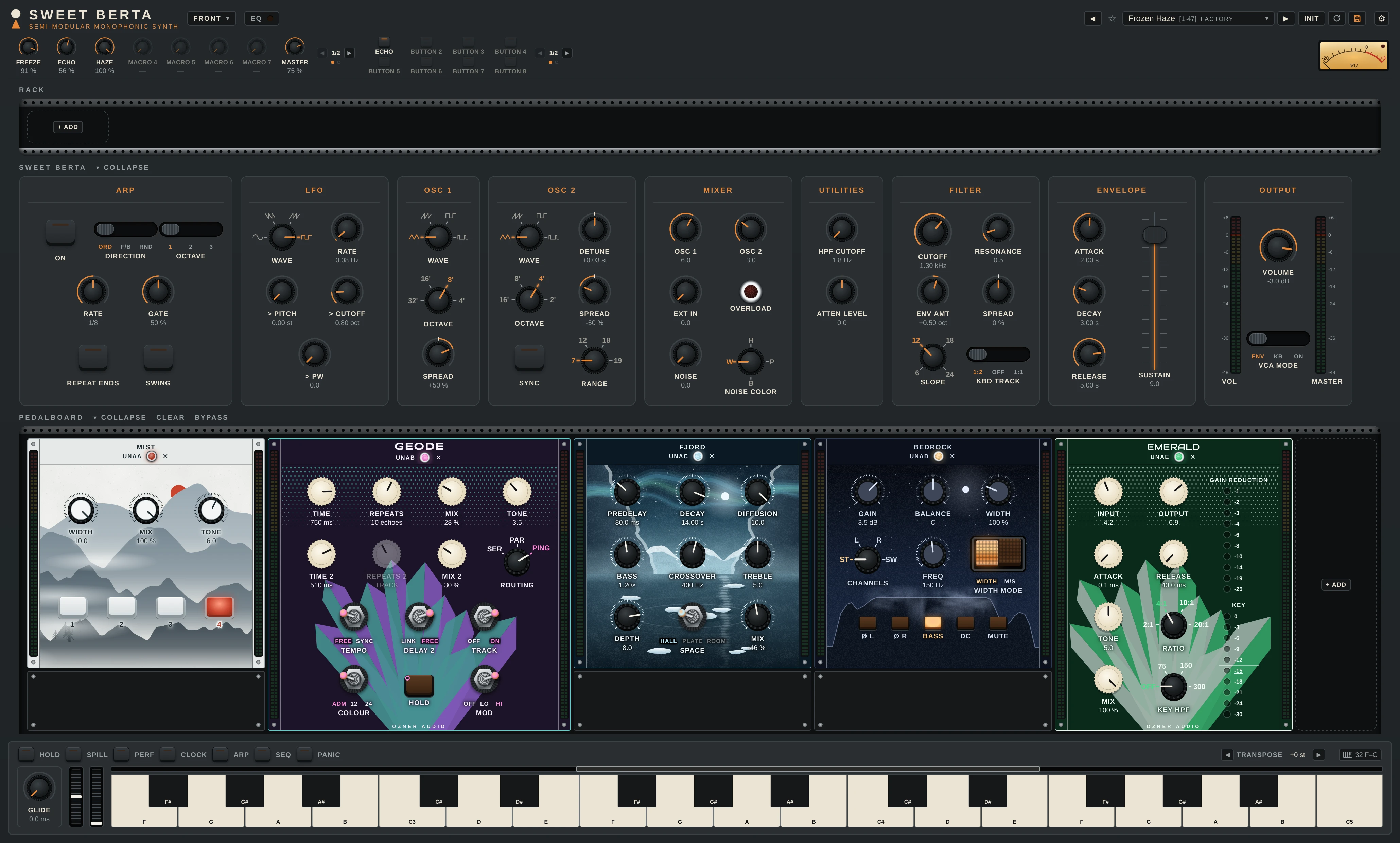
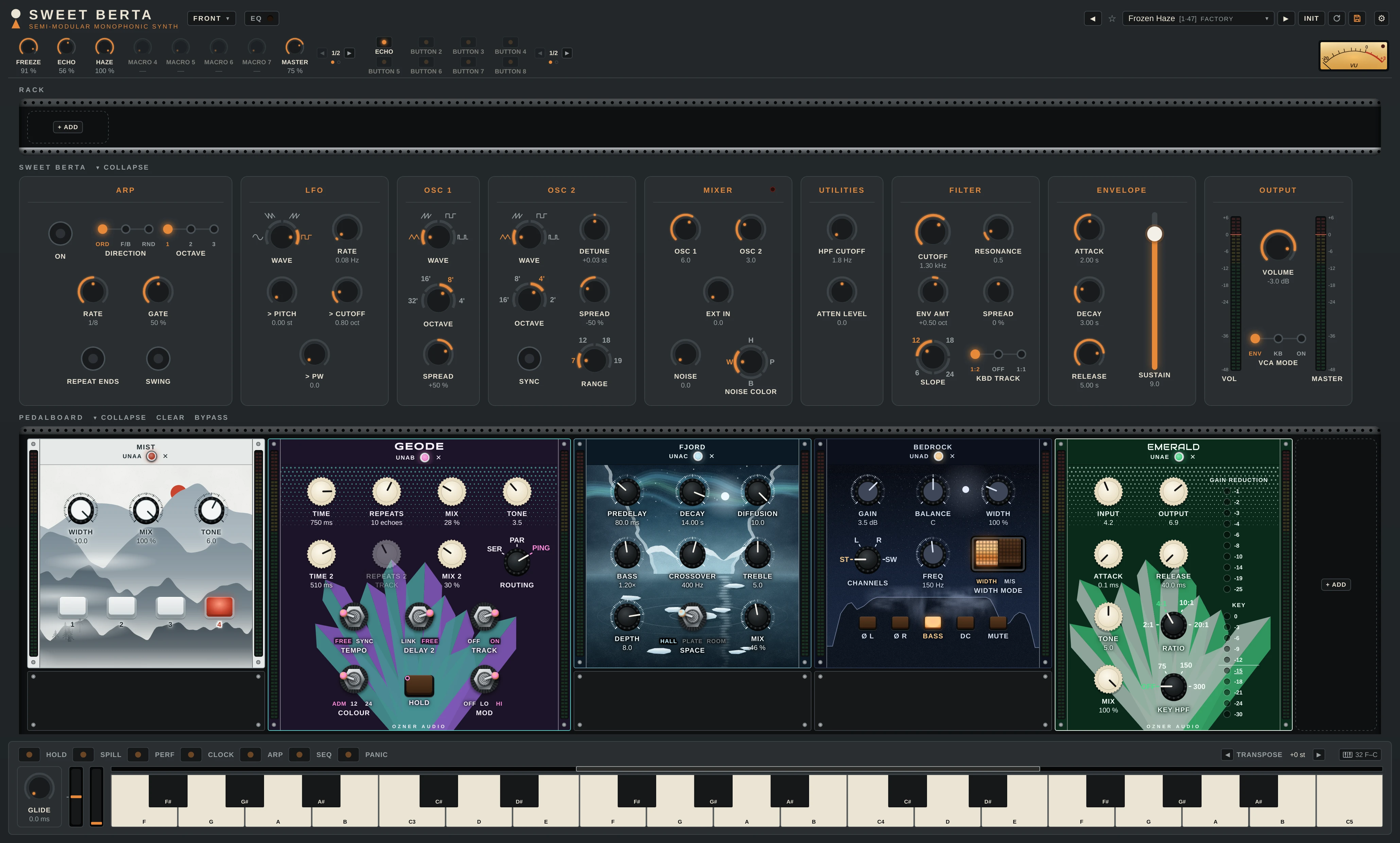
 Modern
An old computer thinking: osc 2 hard-synced, the sample and hold jumping its pitch fourteen times a second, so a held note chatters in bright, random tones of one family, with short echoes. Hold a note for a stream of data; each key is a different machine. The mod wheel brings in a shimmer in the pulse width. Macros: Speed, Tone, Echo. Macro 8, Master, is the output level. Button 1, Sync, is a footswitch for hard sync: let go for the plain interval, press back for the tear. Button 2, Echo, is a footswitch for the echo: off, the repeats ring out (Spillover) and the line goes dry. Button 3, Freeze, is Geode's Hold: the repeats loop what they hold while you play over them, until pressed again. Button 4, Wash, is held: the reverb rings 8 s instead of 1.2 s, a reverb throw on the last note or chord.
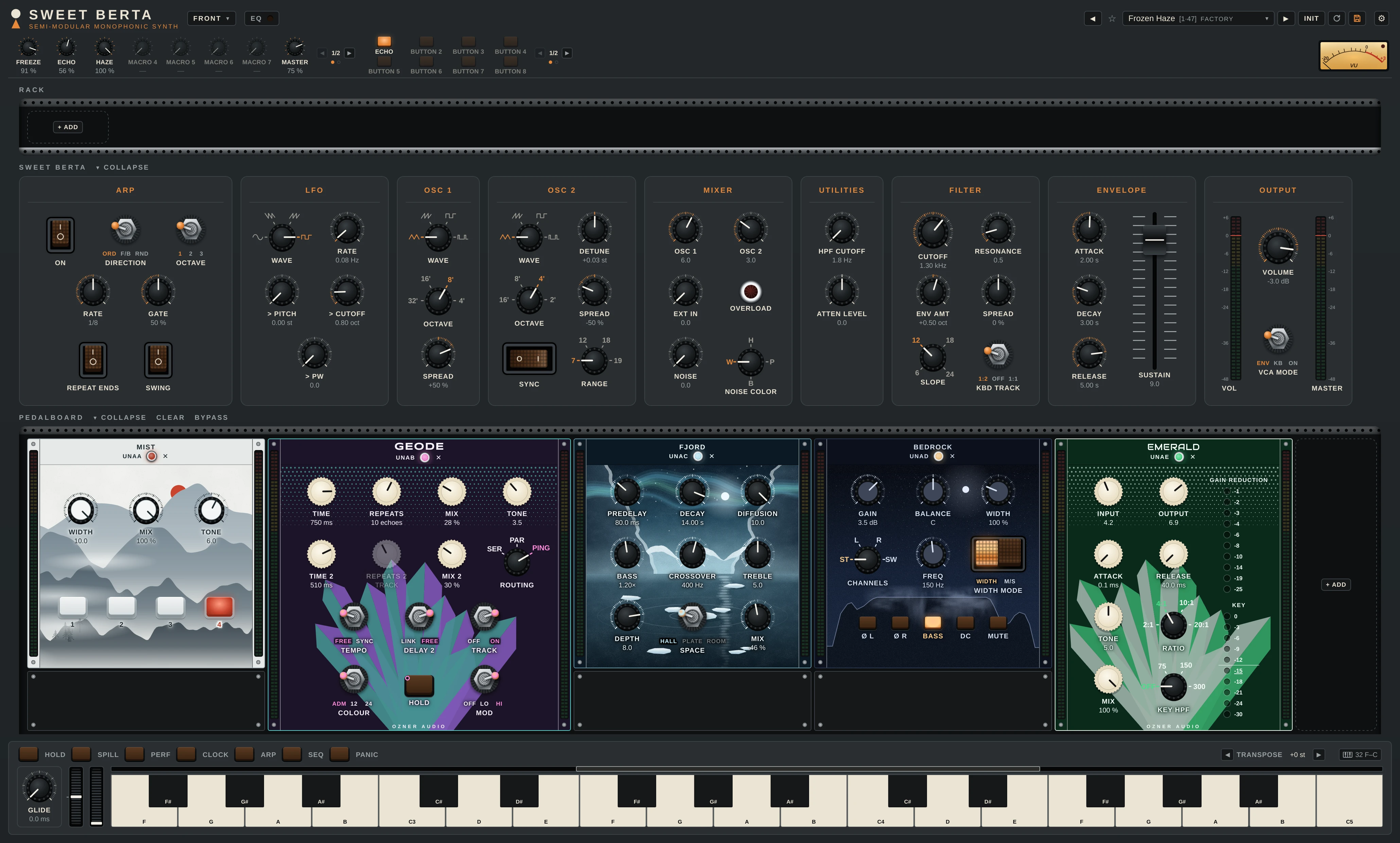
Semi-modular monophonic synth
Sweet Berta
One voice, patched your way. Two oscillators, a ladder filter, a sequencer and an arpeggiator, a patch bay of cables, and a spring reverb.
The launch
Free to claimOpens: November 24, 2026, 12:00 AM UTC. No closing date yet.
Comes with Big Red, unlocked everywhere.
Sweet Berta installs with the Ozner Audio app and a free account. Get the app
The gallery
Every side of the panel, as the plugin draws it241–264 of 313
Waves on a beach: pink noise through a soft ladder, the cutoff and the level rising and falling together every eight seconds or so, into a wide plate. Hold one note as a bed; a higher key brings brighter spray. An Emerald holds the loud corners of the macros level, so the sound sits louder at rest. The mod wheel brings in a gentle vibrato. Macros: Waves, Spray, Space. Macro 8, Master, is the output level. Button 1, Trem, is a footswitch for the tremolo: steady when off. Button 2, Wash, is held: the reverb rings 12 s instead of 4 s, a reverb throw on the last note or chord.
A fire crackling: white noise through the ladder, the sample and hold flinging the cutoff to a new place twenty-five times a second for pops and hiss, under a low brown rumble of the flames, in a small hall. Hold a note as a bed. The mod wheel brings in a gentle vibrato. Macros: Crackle, Glow, Room. Macro 8, Master, is the output level. Button 1, Wash, is held: the reverb rings 8 s instead of 1.2 s, a reverb throw on the last note or chord.
Tuning across a distant radio: the ladder whistles on the edge of self-oscillation over pink static, drifting slowly in pitch, through a narrow, saturated band and a fluttering fade. Hold a note and let it wander; move between keys to retune. The mod wheel brings in a gentle vibrato. Macros: Drift, Static, Band. Macro 8, Master, is the output level. Button 1, Fast, makes the swing four times faster (6.5 to 15 Hz): the slow/fast switch of a rotary or a tremolo.
A buffer stuck and skipping: a saw and a square chopped hard twelve times a second, the sample and hold giving every slice its own brightness, with short echoes repeating the stumble. Hold a note for a stuttering stream; tap for single glitches. The mod wheel brings in a gentle vibrato. Macros: Chop, Colour, Echo. Macro 8, Master, is the output level. Button 1, Trem, is a footswitch for the tremolo: steady when off. Button 2, Echo, is a footswitch for the echo: off, the repeats ring out (Spillover) and the line goes dry. Button 3, Freeze, is Geode's Hold: the repeats loop what they hold while you play over them, until pressed again.
A toy with its wires crossed: osc 1 frequency-modulates osc 2 while the ladder's own output is fed back into osc 1's pitch, so the patch squeals, chirps and lurches unpredictably, into a fuzz. Hold notes and listen to it change; each key behaves differently. The mod wheel brings in a wobble in the filter. Macros: Chaos, Feedback. Macro 8, Master, is the output level. Button 1, Fuzz, is a footswitch for the fuzz: clean when off, the dirt kicked back in by foot.
A heavy steel door slamming in a corridor: osc 1 frequency-modulates osc 2, tuned apart for an inharmonic clang, over a burst of noise, with the springs kicked and a hard, metallic hall. Tap a note; lower keys are bigger doors. The mod wheel brings in a wobble in the filter. Macros: Clang, Ring, Space. Macro 8, Master, is the output level. Button 1, Wash, is held: the reverb rings 8 s instead of 2.5 s, a reverb throw on the last note or chord.
Manual tip: ATTENUATOR OUT -> RATE IN. With nothing in its input the attenuator is a steady offset, and in RATE IN it takes the LFO past the slowest the RATE knob reaches: one cycle here lasts about a minute, sweeping the cutoff two octaves either way under long, detuned saws. Hold a note and let it drift; turn the ATTENUATOR towards 0 to speed it back up. The mod wheel brings in a gentle vibrato. Macros: Atten, Cutoff, Space. Macro 8, Master, is the output level. Button 1, Wash, is held: the reverb rings 14 s instead of 4.5 s, a reverb throw on the last note or chord. Button 2, Chorus, is a footswitch for the chorus: dry and centred when off.
Manual tip: KB OUT -> RATE IN, at half strength. The LFO follows the keys, so the vibrato quickens as you play higher, by half an octave for every octave, as a singer's does on a high note. Bring the mod wheel up for the vibrato and play a slow line across two octaves. Macros: Bright, Echo. Macro 8, Master, is the output level. Button 1, Echo, is a footswitch for the echo: off, the repeats ring out (Spillover) and the line goes dry. Button 2, Freeze, is Geode's Hold: the repeats loop what they hold while you play over them, until pressed again. Button 3, Wash, is held: the reverb rings 8 s instead of 2.2 s, a reverb throw on the last note or chord.
Manual tip: GATE OUT -> LFO SYNC IN, with RATE at its slowest. Each key restarts the LFO, which steps S/H OUT, so every note you play lands on a new random cutoff, and the resonance rings at a new place: the same riff never sounds the same twice. Play short repeated notes. An Emerald shaves the spike of each note, so the body sits louder. The mod wheel brings in a gentle vibrato. Macros: Cutoff, Decay, Echo. Macro 8, Master, is the output level. Button 1, Echo, is a footswitch for the echo: off, the repeats ring out (Spillover) and the line goes dry. Button 2, Freeze, is Geode's Hold: the repeats loop what they hold while you play over them, until pressed again.
Manual tip: OSC 2 -> HPF IN, HPF OUT -> the mixer's OSC 2 IN. Osc 2 is shaped on its own before the mixer: the HPF takes its body away, leaving a buzzy narrow-pulse edge two octaves up, riding on osc 1's full 16' saw, so the brass bites without getting thin. HPF CUTOFF sets how much edge; the mod wheel adds vibrato. Macros: Edge, Bright, Space. Macro 8, Master, is the output level. Button 1, Wash, is held: the reverb rings 8 s instead of 1.8 s, a reverb throw on the last note or chord.
Manual tip: LFO WAVE OUT -> VCA AMT IN, for tremolo. A cable into VCA AMT adds to the envelope's level, so on its own the LFO would hold the VCA open after you let go; ATTENUATOR OUT into the same jack offsets it down by the LFO's depth, so the two only ever dip the level and the note still ends. Soft triangle keys throbbing at 5 Hz. The mod wheel brings in a wobble in the filter. Macros: Rate, Bright, Space. Macro 8, Master, is the output level. Button 1, Chorus, is a footswitch for the chorus: dry and centred when off. Button 2, Wash, is held: the reverb rings 8 s instead of 2.2 s, a reverb throw on the last note or chord.
Manual tip: LFO WAVE OUT -> VCA AMT IN at audio rate, for amplitude modulation. KB OUT -> RATE IN holds the LFO at 1.41 times the note wherever you play, and the ATTENUATOR's offset in VCA AMT keeps the note's end clean, as in the tremolo patch. The sidebands it adds are out of tune with the note: a glassy, metallic chime that grows rougher as it rings away. The mod wheel brings in a wobble in the filter. Macros: Ratio, Decay, Space. Macro 8, Master, is the output level. Button 1, Wash, is held: the reverb rings 10 s instead of 3.5 s, a reverb throw on the last note or chord.
Manual tip: a triangle with one richer wave beside it. Osc 1's triangle carries the note almost pure, and a quiet square on osc 2 an octave up adds the second harmonic, which the key-tracked ladder keeps while it trims the square's own buzz: one partial stands out, with none of a saw's crowd. A breath of pink noise and a soft attack make it a flute; the mod wheel adds vibrato. Macros: Breath, Harmonic, Space. Macro 8, Master, is the output level. Button 1, Wash, is held: the reverb rings 8 s instead of 2.8 s, a reverb throw on the last note or chord.
Manual tip: modulating osc 2's frequency brings hard sync alive. S/H OUT -> OSC 2 PITCH IN throws the synced osc 2 to a new pitch eight times a second, and ATTENUATOR OUT into the same jack lifts it so it never drops under osc 1, where sync goes quiet. The note stays put while each step is a new vowel-like colour: a chattering, talking lead. The mod wheel brings in a wobble in the filter. Macros: Rate, Bright, Echo. Macro 8, Master, is the output level. Button 1, Sync, is a footswitch for hard sync: let go for the plain interval, press back for the tear. Button 2, Echo, is a footswitch for the echo: off, the repeats ring out (Spillover) and the line goes dry. Button 3, Freeze, is Geode's Hold: the repeats loop what they hold while you play over them, until pressed again.
Manual tip: pulse-width modulation as a chorus. Two squares: LFO WAVE OUT -> OSC 1 PWM IN sweeps osc 1's width slowly, and the mod wheel brings in the LFO > PULSE WIDTH normal, which moves both. As the wheel rises the pair thickens and shimmers like an ensemble, with no chorus pedal at all. Hold a note. Macros: Rate, Bright, Space. Macro 8, Master, is the output level. Button 1, Wash, is held: the reverb rings 10 s instead of 3.2 s, a reverb throw on the last note or chord.
Manual tip: KB VEL OUT -> CUTOFF IN. Velocity has no route of its own; patched into CUTOFF IN it lifts the whole filter, by up to two octaves, with how hard you strike, and holds it there for the length of the note, sustain and all. Soft notes are round and mellow, hard ones bark. Play with dynamics. The mod wheel brings in a gentle vibrato. Macros: Cutoff, Decay, Space. Macro 8, Master, is the output level. Button 1, Chorus, is a footswitch for the chorus: dry and centred when off. Button 2, Wash, is held: the reverb rings 8 s instead of 2 s, a reverb throw on the last note or chord.
Manual tip: KB OUT -> CUTOFF IN, on top of KBD TRACK at 1:1. The cutoff now climbs two octaves for every octave played: low notes come out round and muffled, high ones open right up and glassy. One patch, a whole range of colours: play a bass line with the left hand and a bright pluck with the right. The mod wheel brings in a gentle vibrato. Macros: Cutoff, Decay, Echo. Macro 8, Master, is the output level. Button 1, Echo, is a footswitch for the echo: off, the repeats ring out (Spillover) and the line goes dry. Button 2, Freeze, is Geode's Hold: the repeats loop what they hold while you play over them, until pressed again. Button 3, Wash, is held: the reverb rings 8 s instead of 2 s, a reverb throw on the last note or chord.
Manual tip: VCA MODE on KB RLS, with an exaggerated filter envelope. The VCA opens fully the moment a key goes down and holds until you let go, so the envelope only shapes the filter: a hard, resonant snap through five and a half octaves that falls to a closed, dark rumble for as long as you hold. Play staccato for snaps, hold for growl. The mod wheel brings in a wobble in the filter. Macros: Snap, Cutoff, Decay. Macro 8, Master, is the output level. Button 1, Sub, is a 32' floor under the snap. Button 2, Slide, makes tied notes slide; the snap stays on the first.
Manual tip: the mixer is DC-coupled, so it can blend control signals. The oscillators go straight to FILTER IN, freeing the mixer: its OSC 1 IN takes the LFO's smooth sine, OSC 2 IN takes S/H's random steps, the two level knobs set the blend, and MIX OUT -> CUTOFF IN plays the result on the filter: a wobble bass with a random stagger in it. Hold long notes. The mod wheel brings in a gentle vibrato. Macros: Smooth, Steps, Rate. Macro 8, Master, is the output level. Button 1, Sub, is a 32' saw under the wobble.
Manual tip: GATE OUT -> LFO SYNC IN steps S/H once a key, here into osc 2's pitch: every note detunes osc 2 by its own small, random amount, so a line beats and wavers like a worn instrument, never twice the same. Play single notes and slow melodies. The mod wheel brings in a wobble in the filter. Macros: Bright, Decay, Space. Macro 8, Master, is the output level. Button 1, Wash, is held: the reverb rings 8 s instead of 2.4 s, a reverb throw on the last note or chord.
Manual tip: each oscillator through its own filter, for a bass that carries on small speakers. Osc 1, a 16' triangle, goes through the ladder and stays round and low; osc 2, a saw an octave up with its mixer level down, goes through the HPF straight to VCA IN beside FILTER OUT, so only its upper harmonics come through. The line reads on a phone while the low end stays clean. The mod wheel brings in a wobble in the filter. Macros: Edge, Cutoff, Decay. Macro 8, Master, is the output level.
The relentless retro-synth bass: two saws pumping straight sixteenths on one held note, a little filter pluck on each. The Pedalboard splits it in two: one lane stays clean for the low end, the other drives an amp into a steep high-pass, so only its new harmonics join, and the line still reads on a phone. Hold the root and change it with the chords. The mod wheel brings in a wobble in the filter. Macros: Cutoff, Decay, Gate. Macro 8, Master, is the output level. Button 1, Arp, is a footswitch for the arpeggiator: stop the pattern and let the held note ring, start it again on the next bar. Button 2, Roll, is held: the arp runs twice as fast (1/16 to 1/32), a ratchet fill into the next bar. Button 3, Sub, drops osc 1 an octave (16' to 32') under osc 2: the drop section's weight.
An acid line that plays itself: one resonant saw, up and back down over two octaves of whatever you hold, every sixteenth a squelch, with a short slide between steps. Hold a root with its minor third and seventh; harder notes squelch harder. The mod wheel brings in a wobble in the filter. Macros: Cutoff, Squelch, Decay. Macro 8, Master, is the output level. Button 1, Arp, is a footswitch for the arpeggiator: stop the pattern and let the held note ring, start it again on the next bar. Button 2, Roll, is held: the arp runs twice as fast (1/16 to 1/32), a ratchet fill into the next bar.
Changelog
A semi-modular monophonic synth with a patch bay that plays with no cable in it, an arpeggiator and a sequencer locked to your DAW, and its own effects.
New
Play a semi-modular monophonic synth
Two oscillators, noise with a colour selector and an external input feed a mixer, a ladder filter, an envelope, an amplifier and an LFO. The patch bay over it lets you reroute all of it, and it plays with no cable in it. Play it from MIDI, the on-screen keyboard or your computer keys.
Run an arpeggiator locked to your DAW
It plays the keys you hold one at a time, in order, forward and back or at random, over one to three octaves. Steps run from whole notes down to 64th-note triplets, on the DAW's grid, and HOLD keeps the pattern going when you let go.
Write sequences of up to 256 steps
Three sequences, each step a note or a rest, tied to the one before and accented as you like. A key starts a sequence and transposes it, and you can switch sequences from MIDI at the next bar, at the sequence's end or at once.
Add effects as pedals or as modules
Its effects are pedals on one Pedalboard, from board in to board out, or units in the Rack that you patch as modules. Big Red's spring reverb comes with it, unlocked everywhere, and an eight-band EQ sits over the instrument.
Turn sixteen macros for a whole sound
Every sound has sixteen macro knobs and sixteen buttons. A preset names them and points each at the knobs that matter, so a controller you map once follows every preset you load. A button that switches an effect or the arpeggiator is a footswitch: it loads lit, and pressing it switches the thing off.
Bring any sound to life with the mod wheel
The LFO's > Cutoff starts at 0.8 octaves, so the mod wheel wobbles the filter on every sound that has no other job for it, and each sound's description says what the wheel does. The wheel at rest changes nothing.
Keep your level through every sound with Master
Macro 8 is Master: the plugin's output level, from -60 to +6 dB and resting at 0 dB, after the effects and the EQ. It is the plugin's own, so loading a sound leaves it where you put it, and your project saves it. Your DAW can automate it, and a MIDI controller can turn it.
Change sounds without cutting a note
There are 313 factory presets, and you can save your own with a name, tags and an author. Loading one never cuts a held note or a tail.
Reach your own presets from a MIDI controller
Your presets are programs from bank 11 up, each with a number fixed when you save it, counted from 1 as your DAW shows it: bank 11, program 1 loads the first. The browser shows the number and lets you renumber it, and your DAW's program list names them, so a setlist or a controller reaches your sounds as it reaches the factory ones.
Key a pedal from another signal
A pedal's own inputs past In, Emerald's Sidechain In, now show on the Pedalboard's back, so External In or any other jack can drive its squeeze.
Run other audio through the voice
Send another track to Sweet Berta's sidechain input and raise Ext In to run it through the mixer, filter and amplifier. A stereo input stays stereo.
Choose a look and a format
Three looks, Hardware, Hybrid and Modern, change only how the panel looks, never the sound. It runs as AU, VST3 and a standalone app.
Use the Option shortcuts in your DAW too
Option+P, Option+C and Option+A open the pop-ups, and Option+F, B, S, O and E go to a side. Option+Shift+A, S, E and N toggle the arp, the sequencer, the EQ and the patch bay's Normals, and Option+K, H and X toggle Computer Keys and Hold and panic. They work while Sweet Berta's window has focus (Alt on Windows and Linux).