Sweet Berta's panel

Semi-modular monophonic synth

Sweet Berta

One voice, patched your way. Two oscillators, a ladder filter, a sequencer and an arpeggiator, a patch bay of cables, and a spring reverb.

The launch

Free to claim

Opens: November 24, 2026, 12:00 AM UTC. No closing date yet.

Comes with Big Red, unlocked everywhere.

Sweet Berta installs with the Ozner Audio app and a free account. Get the app

AUVST3Standalone

The gallery

Every side of the panel, as the plugin draws it
The Front

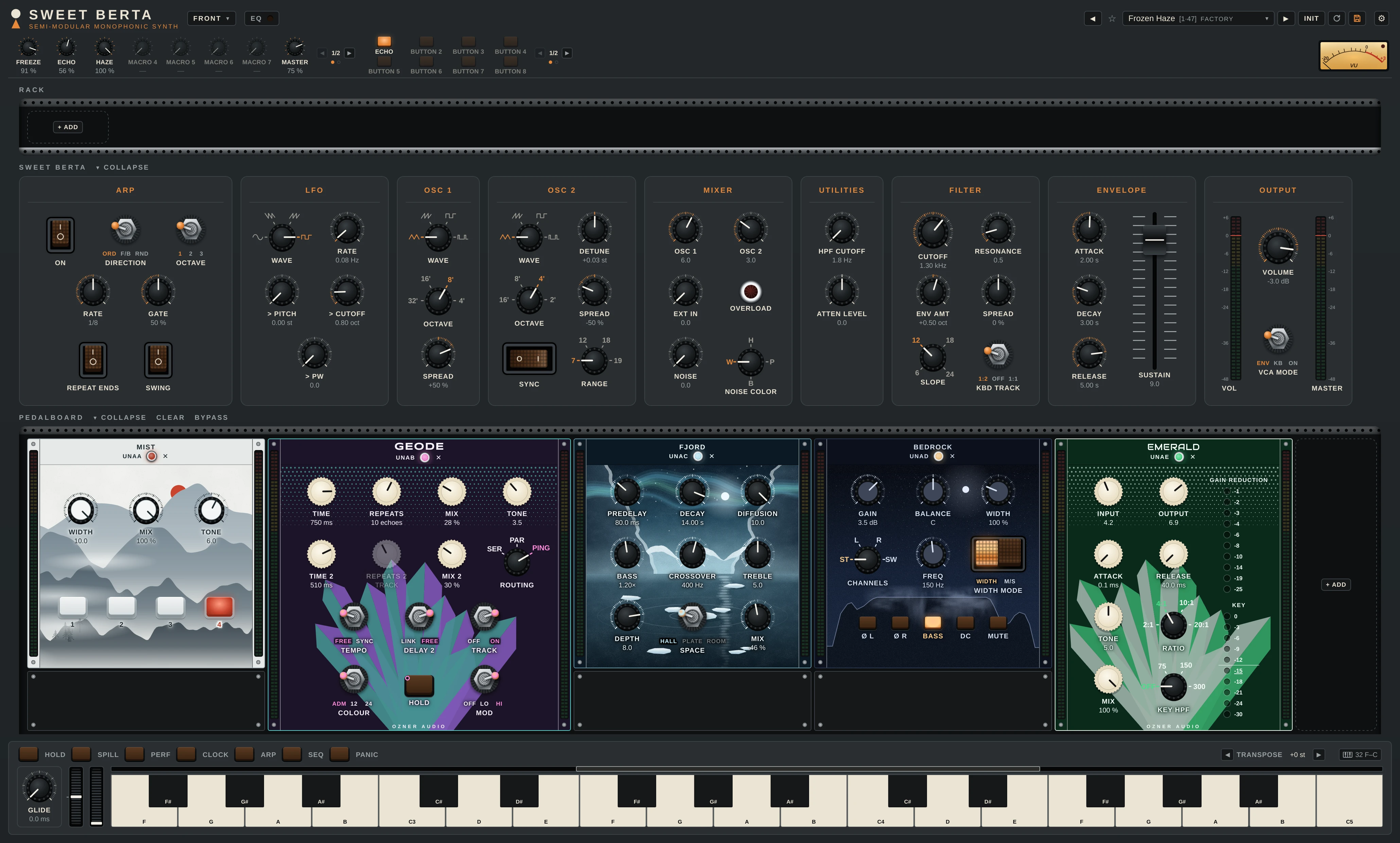
The Front. The Pedalboard with its pedals under the synth's modules, the macros above and the keyboard below, in the Hardware theme.

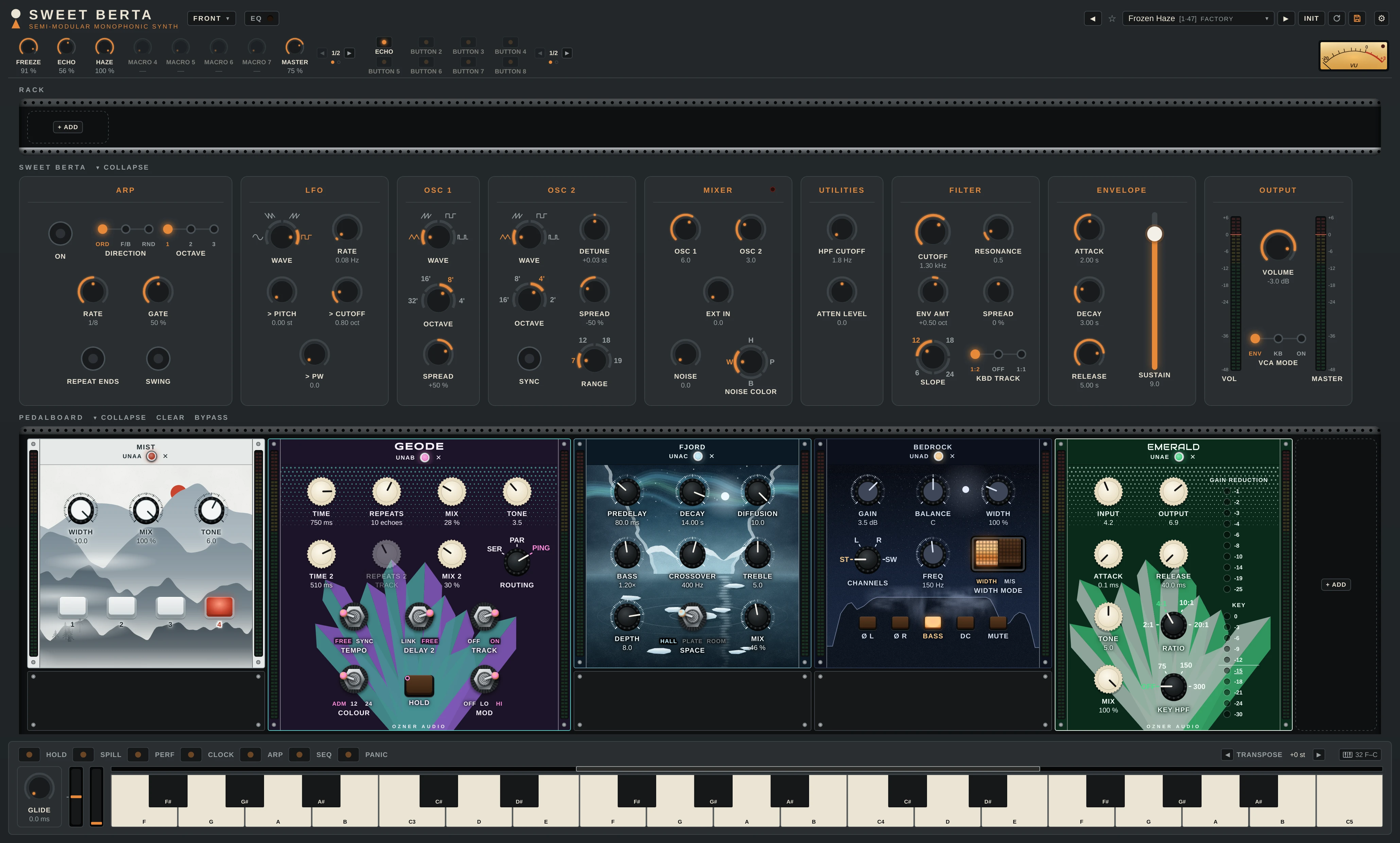
Three looks

Settings › Theme, any time: the sound never changes
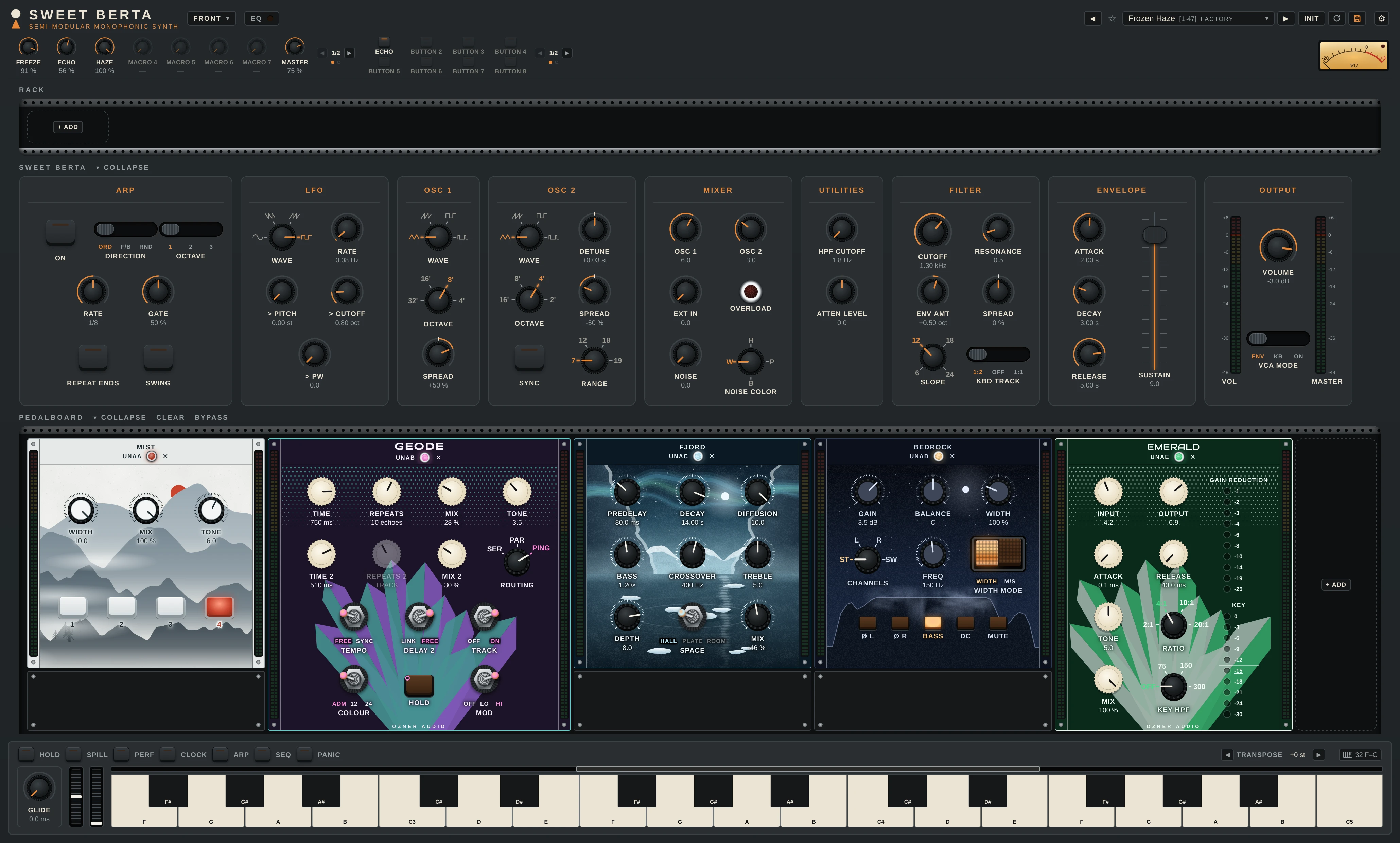
The Front in the Hybrid theme

Hybrid

Slide switches, keycaps and knurled knobs: gear drawn flatter, still with a hand on it.

Left to right, the order the panel draws them: every control, as its hover label says it.

Arp

On

Plays the held keys as an arpeggio; switches the sequencer off.

Direction

The arp's notes or the sequence's steps in order, that order then back (Fwd/Bkwd), or at random.

Octave

Plays the pattern over 1, 2 or 3 octaves.

Rate

Each step's length, as a division of the clock's tempo.

Gate

How much of each step its note lasts; a tied sequencer step holds it on.

Repeat Ends

Fwd/Bkwd plays the end notes or steps twice at each turn (A B C C B A), or once (A B C B).

Swing

Follow the Clock's Swing.

LFO

Wave

The LFO's shape: sine, falling sawtooth, rising ramp or square.

Rate

How fast the LFO cycles, up to audio rate.

> Pitch

How far the LFO moves both oscillators' pitch, at full mod wheel.

> Cutoff

How far the LFO moves the cutoff, at full mod wheel.

> PW

How far the LFO moves the pulse width, at full mod wheel.

OSC 1

Wave

Osc 1's waveform: triangle, saw, square or narrow pulse.

Octave

Osc 1's range: 8' is the played note, each halving an octave up.

Spread

Spreads osc 1 apart in stereo.

OSC 2

Wave

Osc 2's waveform: triangle, saw, square or narrow pulse.

Detune

Osc 2's tuning against osc 1, up to the Range's semitones either way (about 36 with Sync on, whatever the Range).

Octave

Osc 2's range, which sits an octave above osc 1's.

Spread

Spreads osc 2 apart in stereo.

Sync

Hard-syncs osc 2 to osc 1: each cycle of osc 1 restarts osc 2.

Range

How far Detune turns, in semitones either way: 7 a fifth, 12 an octave, 18 the widest the classic hardware allows, and 19 (ours) an octave and a fifth. A global setting, brought onto the panel and saved with each preset. Moving it moves no pitch.

Mixer

Osc 1

Osc 1's level into the mixer; the stage bends from the first level, by 1 dB at about 7.7 with osc 1 alone.

Osc 2

Osc 2's level into the mixer.

Ext In

The external input's level into the mixer, or that of whatever is patched into the Ext In jack.

Noise

The noise's level into the mixer.

Noise Color

The noise's colour: white, hybrid, pink or brown.

Utilities

HPF Cutoff

The high-pass filter's cutoff: patch HPF In and HPF Out to hear it.

Atten Level

Atten Out's level with nothing in Atten In; with a cable in, how much of it passes (below 0 inverts).

Filter

Cutoff

The ladder filter's cutoff frequency.

Resonance

Emphasis at the cutoff; near the top the filter sings on its own.

Env Amt

How far the envelope moves the cutoff, up or down.

Spread

Spreads the two sides' cutoffs apart in stereo.

Slope

How many of the ladder's stages the sound leaves after (dB/oct). 24 is the classic, deep and round; 18 a touch more open; 12 brighter and buzzier, its resonance sharper; 6 very gentle.

Kbd Track

How far the cutoff follows the keys: 1:1 tracks them a little more than all the way.

Envelope

Attack

How long the envelope takes to rise.

Decay

How long the envelope takes to fall to the sustain level.

Release

How long the envelope takes to fade once the key is up.

Sustain

The level the envelope holds while a key is down.

Output

Volume

The voice's level, into the effects.

VCA Mode

What opens the VCA: the envelope, full level until the key's release (KB Rls), or always (Drone).

On the keyboard bar

Performance

Note Priority

Which held key sounds when more than one is down.

Legato Glide

On: only overlapping notes glide, and a detached note jumps.

Glide

How long the pitch takes to slide to a new note.

Drift

A slow random wander of each oscillator's pitch.

Transpose

Shifts everything the synth plays, in semitones.

Bend Range

How far the pitch wheel bends, in semitones either way.

Clock

Sync

Host follows the DAW's tempo and play/stop (in the Standalone, the external MIDI clock's, once one is heard); Internal always runs at Rate.

Rate

The tempo at Internal sync, and at Host for a DAW that reports none; Tap sets it.

Swing

Delays every second step: 50% is straight; higher lengthens the first of each pair.

Tap

Press in time to set the clock's Rate.

Changelog

1.0.0

A semi-modular monophonic synth with a patch bay that plays with no cable in it, an arpeggiator and a sequencer locked to your DAW, and its own effects.

New

  • Play a semi-modular monophonic synth

    Two oscillators, noise with a colour selector and an external input feed a mixer, a ladder filter, an envelope, an amplifier and an LFO. The patch bay over it lets you reroute all of it, and it plays with no cable in it. Play it from MIDI, the on-screen keyboard or your computer keys.

  • Run an arpeggiator locked to your DAW

    It plays the keys you hold one at a time, in order, forward and back or at random, over one to three octaves. Steps run from whole notes down to 64th-note triplets, on the DAW's grid, and HOLD keeps the pattern going when you let go.

  • Write sequences of up to 256 steps

    Three sequences, each step a note or a rest, tied to the one before and accented as you like. A key starts a sequence and transposes it, and you can switch sequences from MIDI at the next bar, at the sequence's end or at once.

  • Add effects as pedals or as modules

    Its effects are pedals on one Pedalboard, from board in to board out, or units in the Rack that you patch as modules. Big Red's spring reverb comes with it, unlocked everywhere, and an eight-band EQ sits over the instrument.

  • Turn sixteen macros for a whole sound

    Every sound has sixteen macro knobs and sixteen buttons. A preset names them and points each at the knobs that matter, so a controller you map once follows every preset you load. A button that switches an effect or the arpeggiator is a footswitch: it loads lit, and pressing it switches the thing off.

  • Bring any sound to life with the mod wheel

    The LFO's > Cutoff starts at 0.8 octaves, so the mod wheel wobbles the filter on every sound that has no other job for it, and each sound's description says what the wheel does. The wheel at rest changes nothing.

  • Keep your level through every sound with Master

    Macro 8 is Master: the plugin's output level, from -60 to +6 dB and resting at 0 dB, after the effects and the EQ. It is the plugin's own, so loading a sound leaves it where you put it, and your project saves it. Your DAW can automate it, and a MIDI controller can turn it.

  • Change sounds without cutting a note

    There are 313 factory presets, and you can save your own with a name, tags and an author. Loading one never cuts a held note or a tail.

  • Reach your own presets from a MIDI controller

    Your presets are programs from bank 11 up, each with a number fixed when you save it, counted from 1 as your DAW shows it: bank 11, program 1 loads the first. The browser shows the number and lets you renumber it, and your DAW's program list names them, so a setlist or a controller reaches your sounds as it reaches the factory ones.

  • Key a pedal from another signal

    A pedal's own inputs past In, Emerald's Sidechain In, now show on the Pedalboard's back, so External In or any other jack can drive its squeeze.

  • Run other audio through the voice

    Send another track to Sweet Berta's sidechain input and raise Ext In to run it through the mixer, filter and amplifier. A stereo input stays stereo.

  • Choose a look and a format

    Three looks, Hardware, Hybrid and Modern, change only how the panel looks, never the sound. It runs as AU, VST3 and a standalone app.

  • Use the Option shortcuts in your DAW too

    Option+P, Option+C and Option+A open the pop-ups, and Option+F, B, S, O and E go to a side. Option+Shift+A, S, E and N toggle the arp, the sequencer, the EQ and the patch bay's Normals, and Option+K, H and X toggle Computer Keys and Hold and panic. They work while Sweet Berta's window has focus (Alt on Windows and Linux).