Sweet Berta's panel

Semi-modular monophonic synth

Sweet Berta

One voice, patched your way. Two oscillators, a ladder filter, a sequencer and an arpeggiator, a patch bay of cables, and a spring reverb.

The launch

Free to claim

Opens: November 24, 2026, 12:00 AM UTC. No closing date yet.

Comes with Big Red, unlocked everywhere.

Sweet Berta installs with the Ozner Audio app and a free account. Get the app

AUVST3Standalone

The gallery

Every side of the panel, as the plugin draws it
The Front

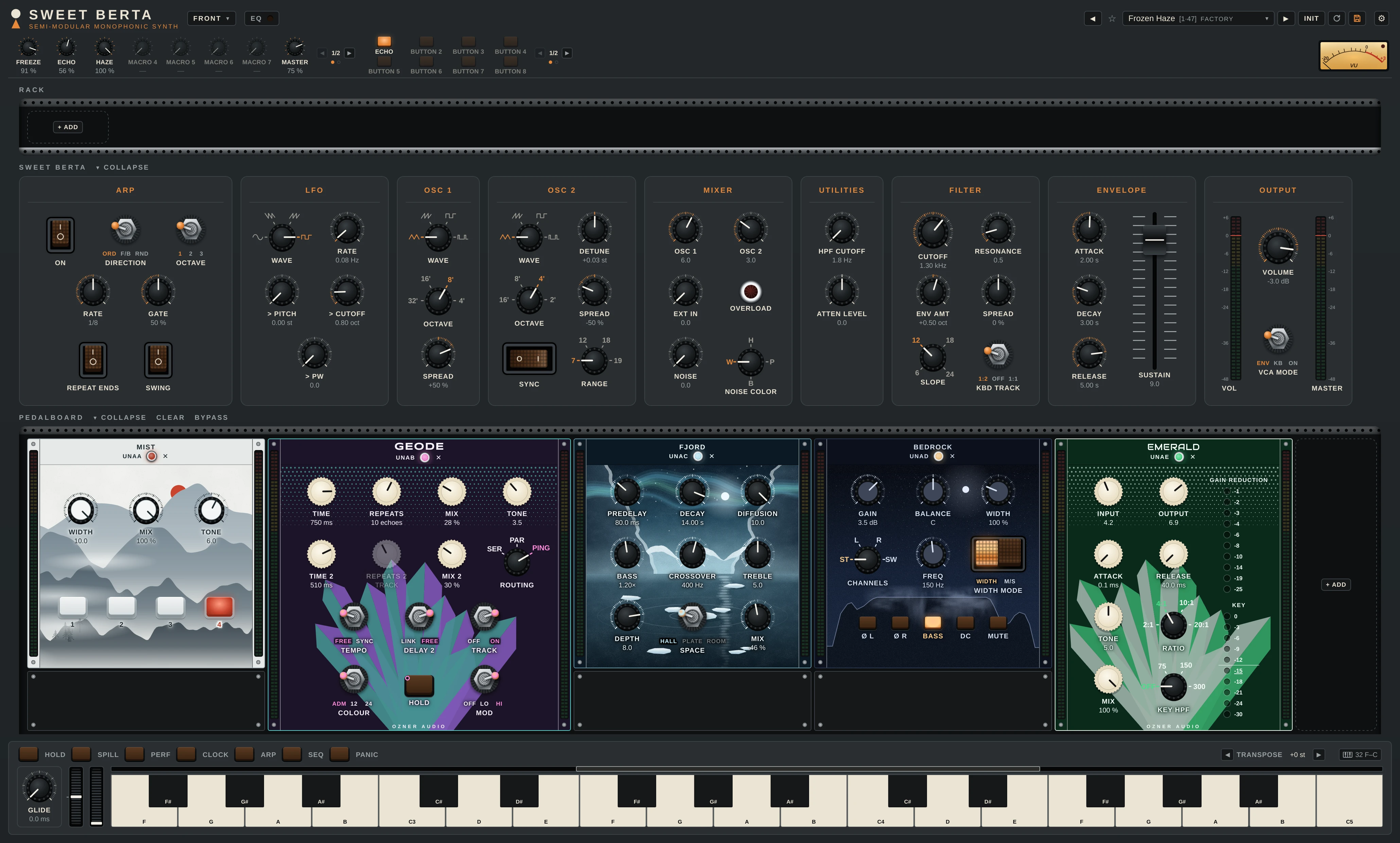
The Front. The Pedalboard with its pedals under the synth's modules, the macros above and the keyboard below, in the Hardware theme.

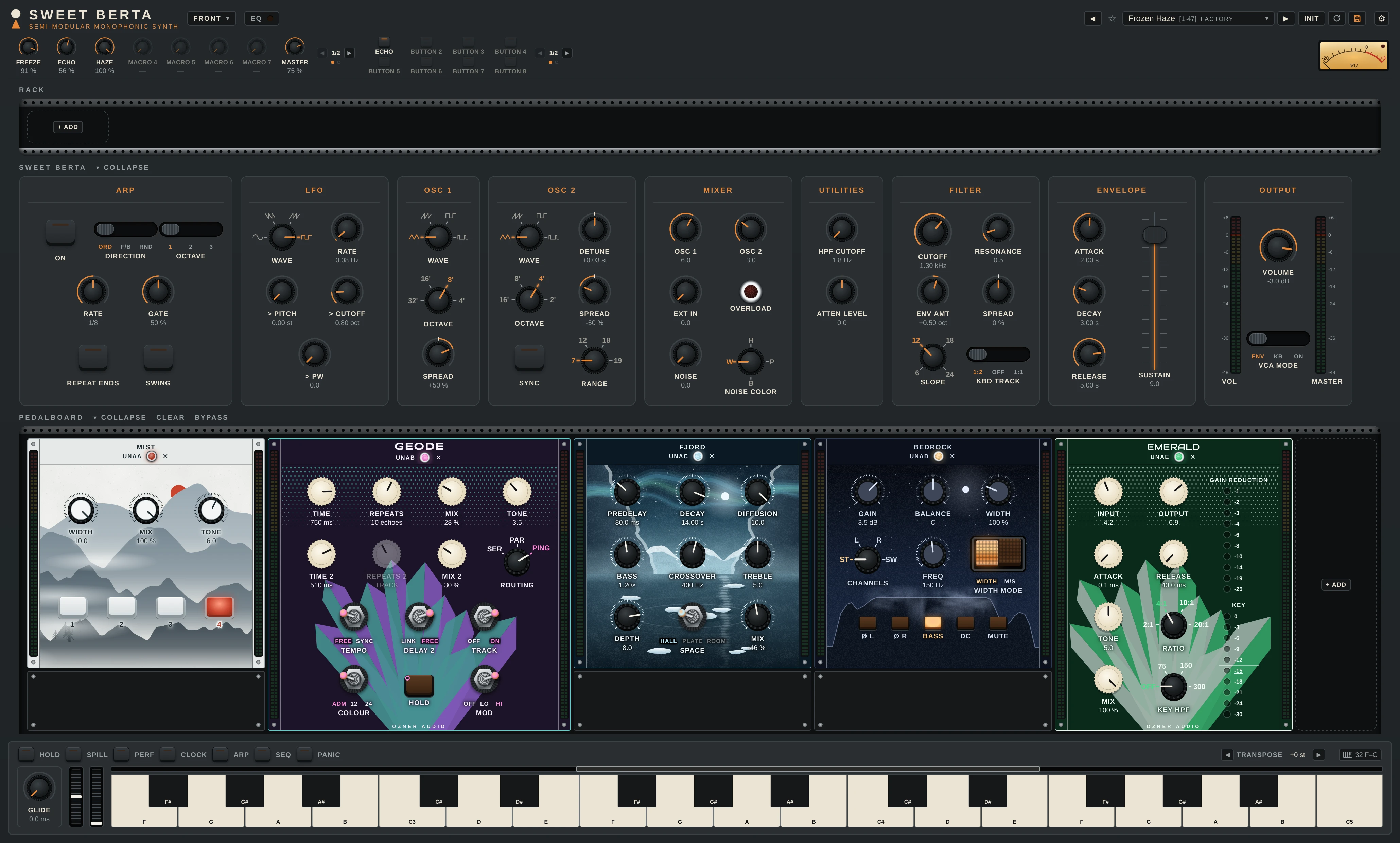
Three looks

Settings › Theme, any time: the sound never changes
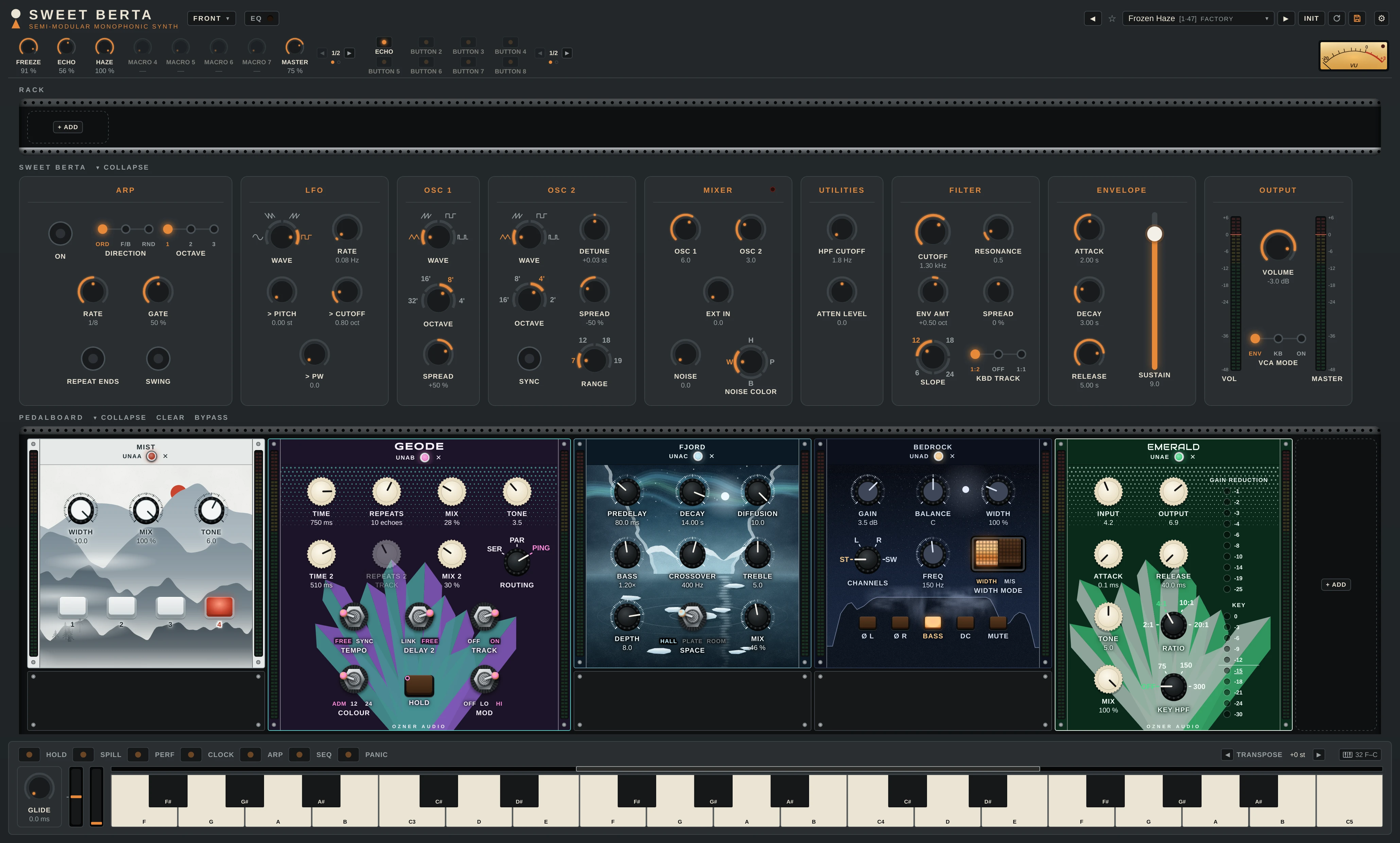
The Front in the Modern theme

Modern

Flat tracks and glowing segments: the quietest panel, the same synth.

Normalled as the hardware is, so it plays with no cable at all; a cable into a jack breaks its normal and reroutes it. Inputs on the left of each group, outputs on the right.

LFO

INRate In

Adds to the LFO's Rate knob; a stereo cable runs a left and a right LFO, each at its own rate.

INSync In

Restarts the LFO's cycle on a rising edge; a stereo cable restarts each side's LFO on its own.

OUTS/H Out

Noise sampled at the start of each LFO cycle.

OUTWave Out

The LFO itself, not scaled by the mod wheel.

Osc 1

INPitch In

Replaces the LFO's pitch modulation; the keys still play osc 1.

INPWM In

Moves osc 1's pulse width (Square and Narrow Pulse).

OUTWave Out

Osc 1's waveform.

Osc 2

INPitch In

Replaces the LFO's pitch modulation; the keys still play osc 2.

INLin FM In

Linear FM: moves osc 2's frequency in Hz, for bells and clangs.

OUTWave Out

Osc 2's waveform.

Mixer

INOsc 1 In

Replaces osc 1 as the mixer's Osc 1 channel.

INOsc 2 In

Replaces osc 2 as the mixer's Osc 2 channel.

INNoise In

Replaces the noise as the mixer's Noise channel.

INExt In

Replaces the external audio input as the mixer's Ext In channel; the Ext In knob sets its level. Euro Out into it feeds the voice back through the mixer.

OUTNoise Out

The mixer's noise in the colour Noise Color selects, before its level knob.

OUTExt Out

The external input's signal, before its mixer level. Cable it to a unit's Sidechain In to key it; the cable's amount is how much is sent.

OUTMix Out

The mixer's output, its overdrive included.

Utilities

INHPF In

The high-pass filter's input: nothing reaches it until patched.

INAtten In

What the attenuator scales; with nothing in, a constant (+DC).

OUTHPF Out

The high-pass filter's output.

OUTAtten Out

The Attenuator knob times Atten In, or the knob's own level.

Filter

INFilter In

Replaces the mixer as the filter's input.

INCutoff In

Moves the cutoff, on top of the knob and everything else.

INEnv Amt In

Adds to the Env Amt knob: the envelope's depth on the cutoff.

OUTFilter Out

The filter's output.

Envelope

INTrig In

Gates the envelope in place of the keyboard; a stereo cable gates each side's envelope on its own.

OUT+Env Out

The envelope, from 0 up to 1.

OUT−Env Out

The envelope upside down, from 0 down to -1.

Output

INVCA In

Replaces the filter as the VCA's audio input.

INVCA Amt In

Opens the VCA further, on top of its mode's level.

INMaster In

What the plugin plays: Board Out, or whatever is patched here instead.

OUTKB Out

The played note's pitch.

OUTKB Vel Out

The last note's velocity, or the sequencer's accent while it is on.

OUTGate Out

High while a key is down, or while an arp or sequencer step is gated.

OUTEuro Out

The finished voice before the volume: Main Out at 0 dB, however the volume is set. Into Ext In it feeds the voice back the same at any volume.

OUTMain Out

The finished voice, after the VCA and the volume, before any effect.

Pedalboard

INBoard In

What the Pedalboard's effects play: Main Out, or whatever is patched here instead.

OUTBoard Out

The Pedalboard's end: its last effect's output, or Board In with no effect.

Changelog

1.0.0

A semi-modular monophonic synth with a patch bay that plays with no cable in it, an arpeggiator and a sequencer locked to your DAW, and its own effects.

New

  • Play a semi-modular monophonic synth

    Two oscillators, noise with a colour selector and an external input feed a mixer, a ladder filter, an envelope, an amplifier and an LFO. The patch bay over it lets you reroute all of it, and it plays with no cable in it. Play it from MIDI, the on-screen keyboard or your computer keys.

  • Run an arpeggiator locked to your DAW

    It plays the keys you hold one at a time, in order, forward and back or at random, over one to three octaves. Steps run from whole notes down to 64th-note triplets, on the DAW's grid, and HOLD keeps the pattern going when you let go.

  • Write sequences of up to 256 steps

    Three sequences, each step a note or a rest, tied to the one before and accented as you like. A key starts a sequence and transposes it, and you can switch sequences from MIDI at the next bar, at the sequence's end or at once.

  • Add effects as pedals or as modules

    Its effects are pedals on one Pedalboard, from board in to board out, or units in the Rack that you patch as modules. Big Red's spring reverb comes with it, unlocked everywhere, and an eight-band EQ sits over the instrument.

  • Turn sixteen macros for a whole sound

    Every sound has sixteen macro knobs and sixteen buttons. A preset names them and points each at the knobs that matter, so a controller you map once follows every preset you load. A button that switches an effect or the arpeggiator is a footswitch: it loads lit, and pressing it switches the thing off.

  • Bring any sound to life with the mod wheel

    The LFO's > Cutoff starts at 0.8 octaves, so the mod wheel wobbles the filter on every sound that has no other job for it, and each sound's description says what the wheel does. The wheel at rest changes nothing.

  • Keep your level through every sound with Master

    Macro 8 is Master: the plugin's output level, from -60 to +6 dB and resting at 0 dB, after the effects and the EQ. It is the plugin's own, so loading a sound leaves it where you put it, and your project saves it. Your DAW can automate it, and a MIDI controller can turn it.

  • Change sounds without cutting a note

    There are 313 factory presets, and you can save your own with a name, tags and an author. Loading one never cuts a held note or a tail.

  • Reach your own presets from a MIDI controller

    Your presets are programs from bank 11 up, each with a number fixed when you save it, counted from 1 as your DAW shows it: bank 11, program 1 loads the first. The browser shows the number and lets you renumber it, and your DAW's program list names them, so a setlist or a controller reaches your sounds as it reaches the factory ones.

  • Key a pedal from another signal

    A pedal's own inputs past In, Emerald's Sidechain In, now show on the Pedalboard's back, so External In or any other jack can drive its squeeze.

  • Run other audio through the voice

    Send another track to Sweet Berta's sidechain input and raise Ext In to run it through the mixer, filter and amplifier. A stereo input stays stereo.

  • Choose a look and a format

    Three looks, Hardware, Hybrid and Modern, change only how the panel looks, never the sound. It runs as AU, VST3 and a standalone app.

  • Use the Option shortcuts in your DAW too

    Option+P, Option+C and Option+A open the pop-ups, and Option+F, B, S, O and E go to a side. Option+Shift+A, S, E and N toggle the arp, the sequencer, the EQ and the patch bay's Normals, and Option+K, H and X toggle Computer Keys and Hold and panic. They work while Sweet Berta's window has focus (Alt on Windows and Linux).