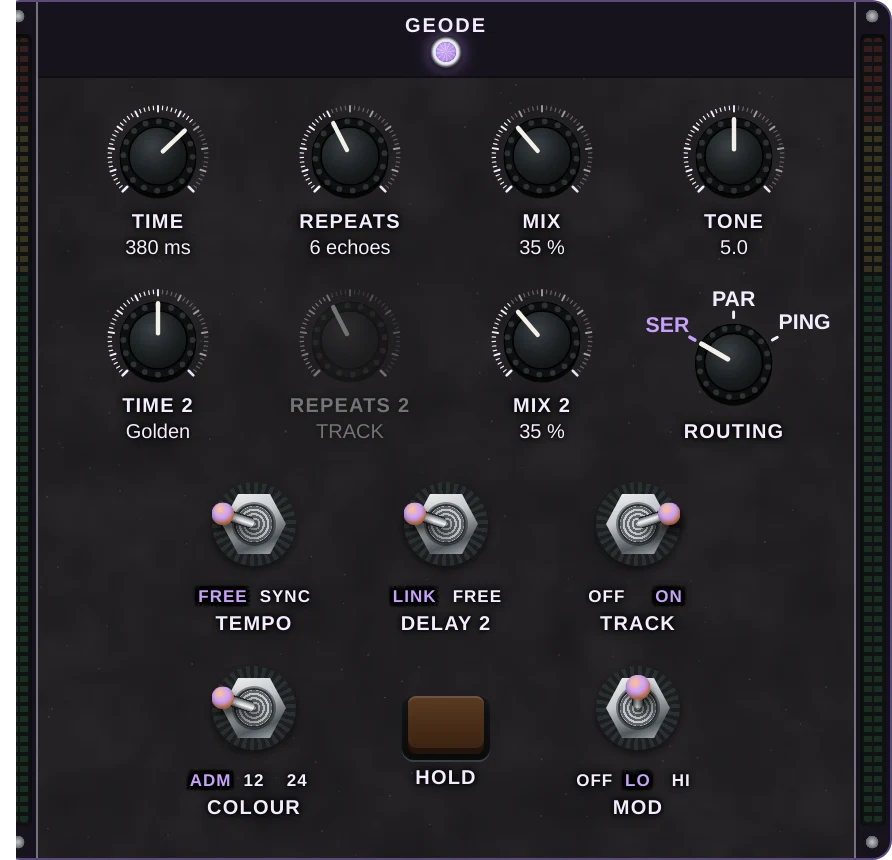
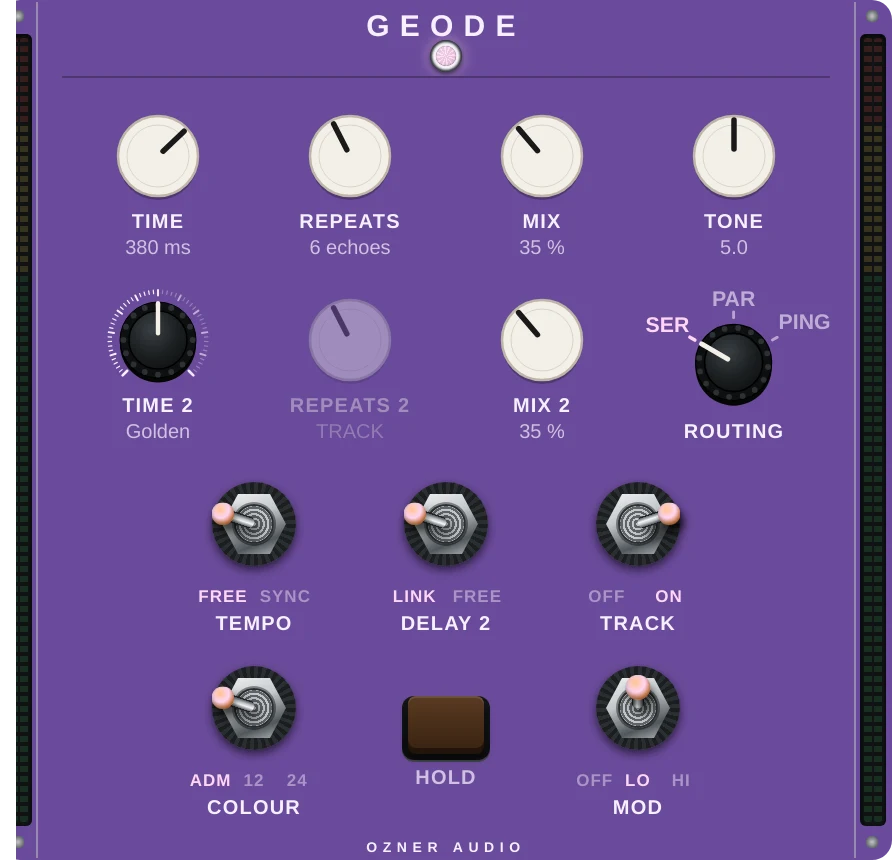
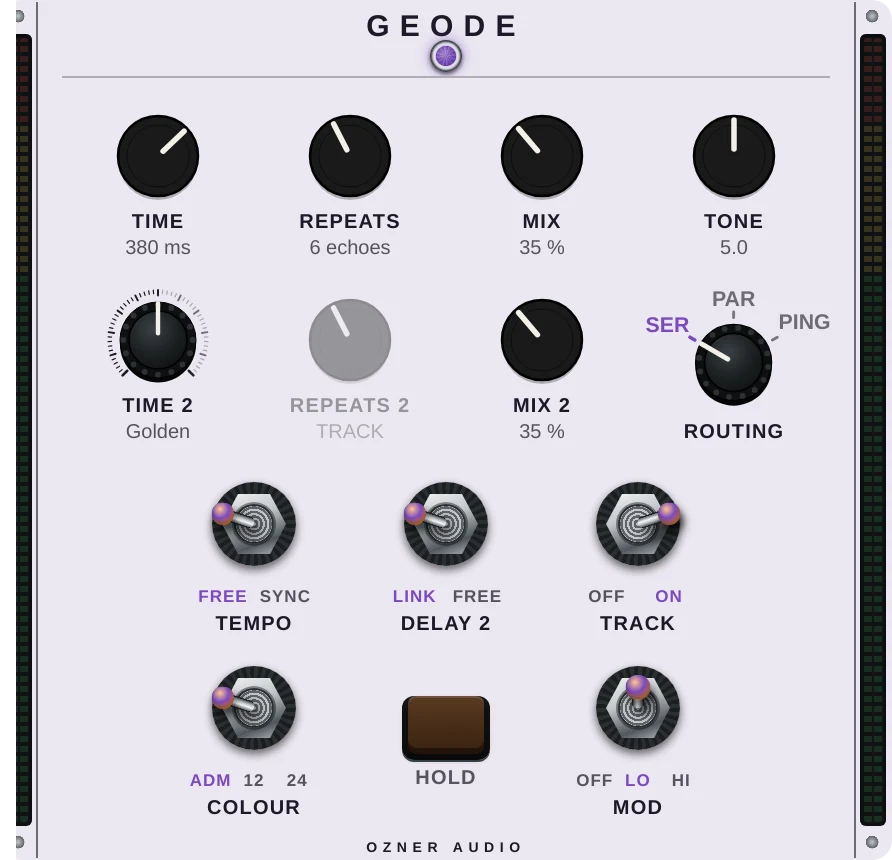
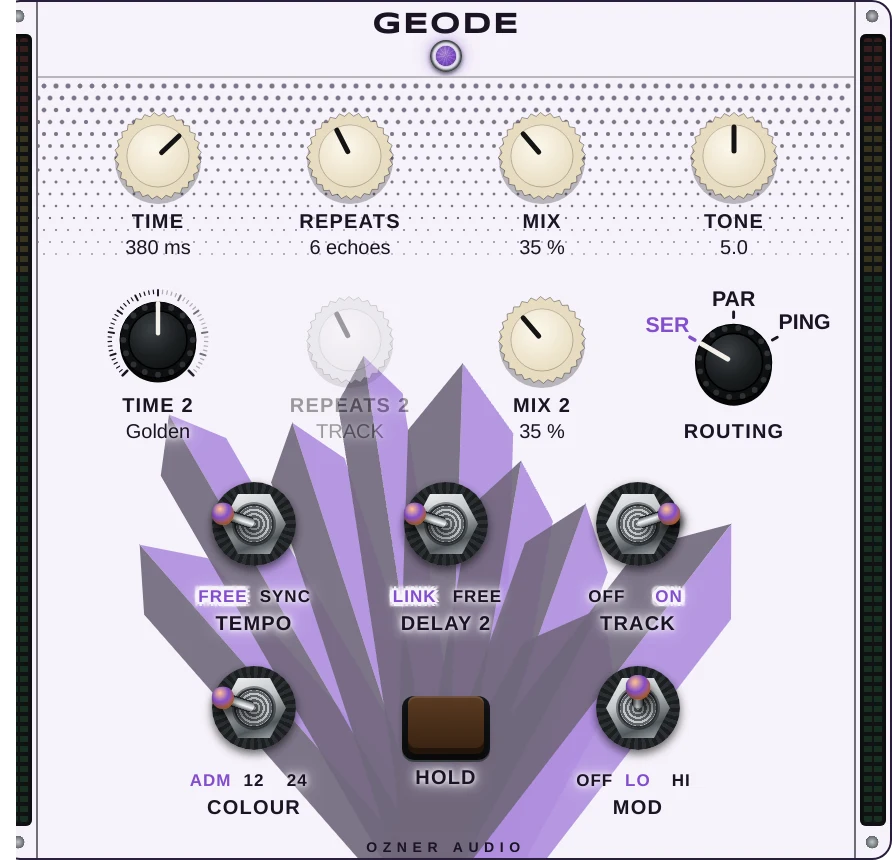
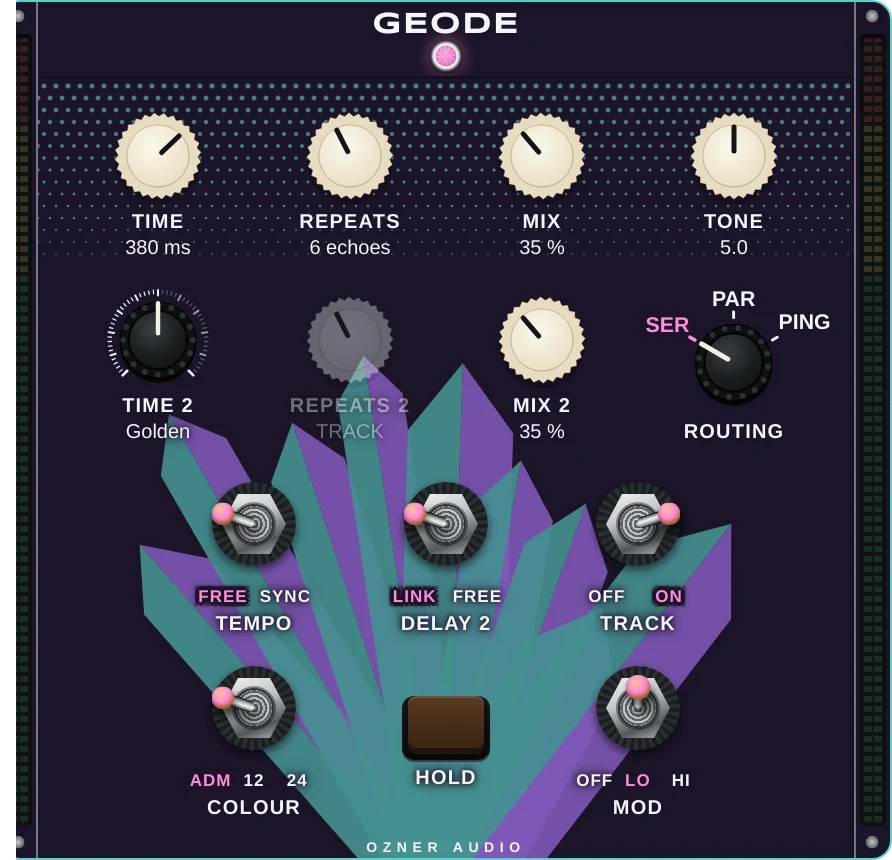
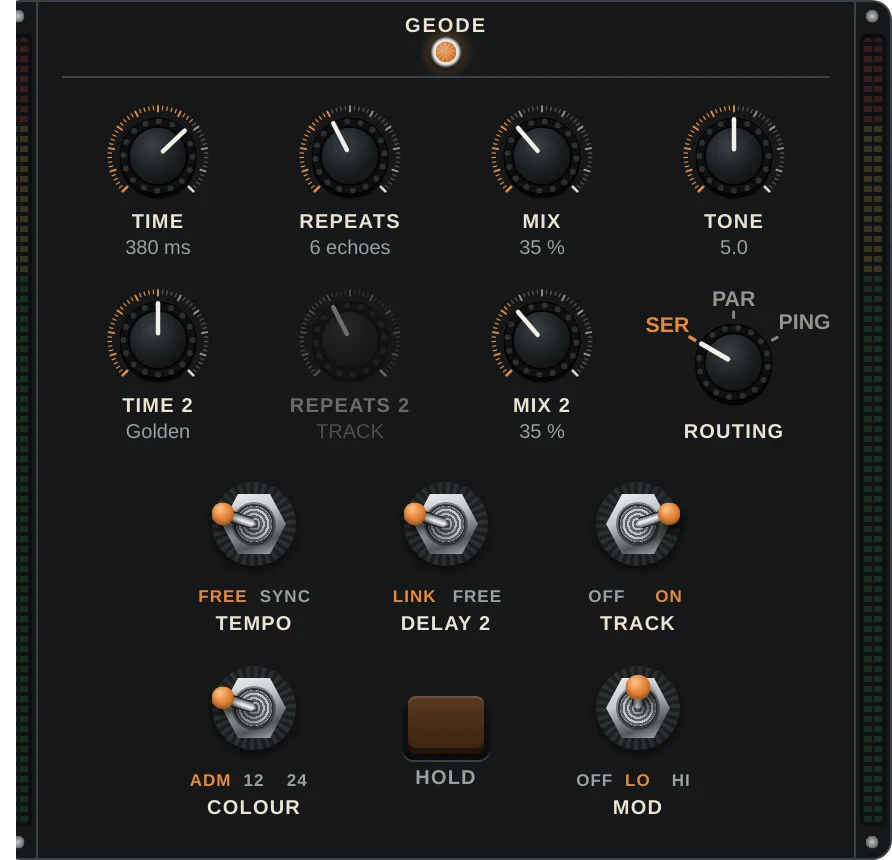
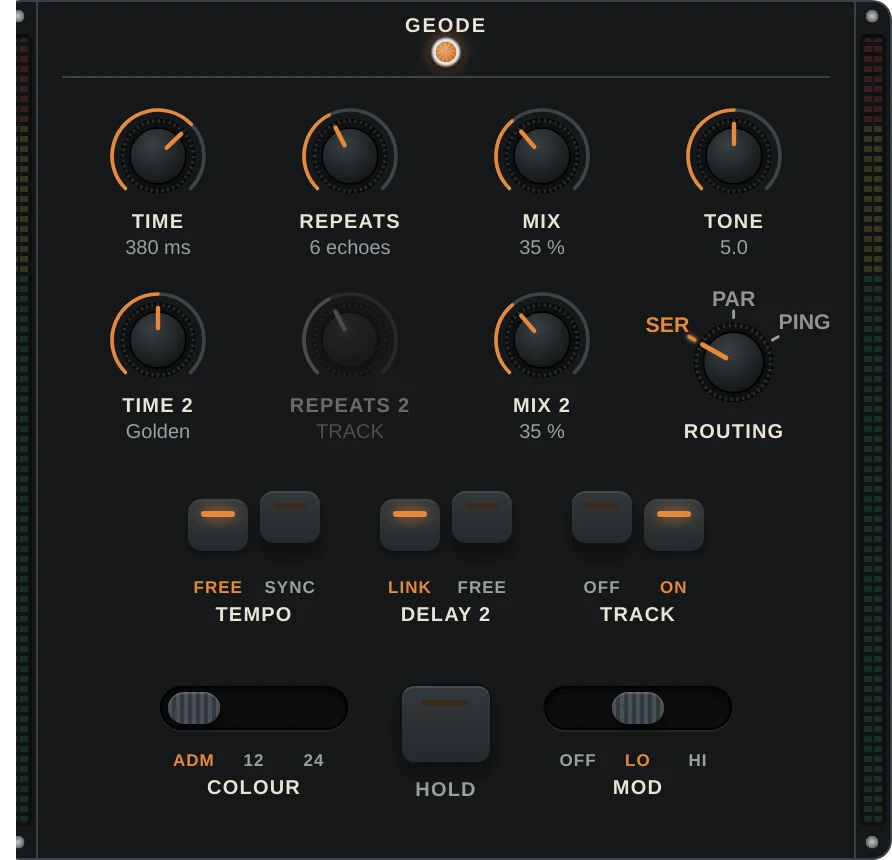
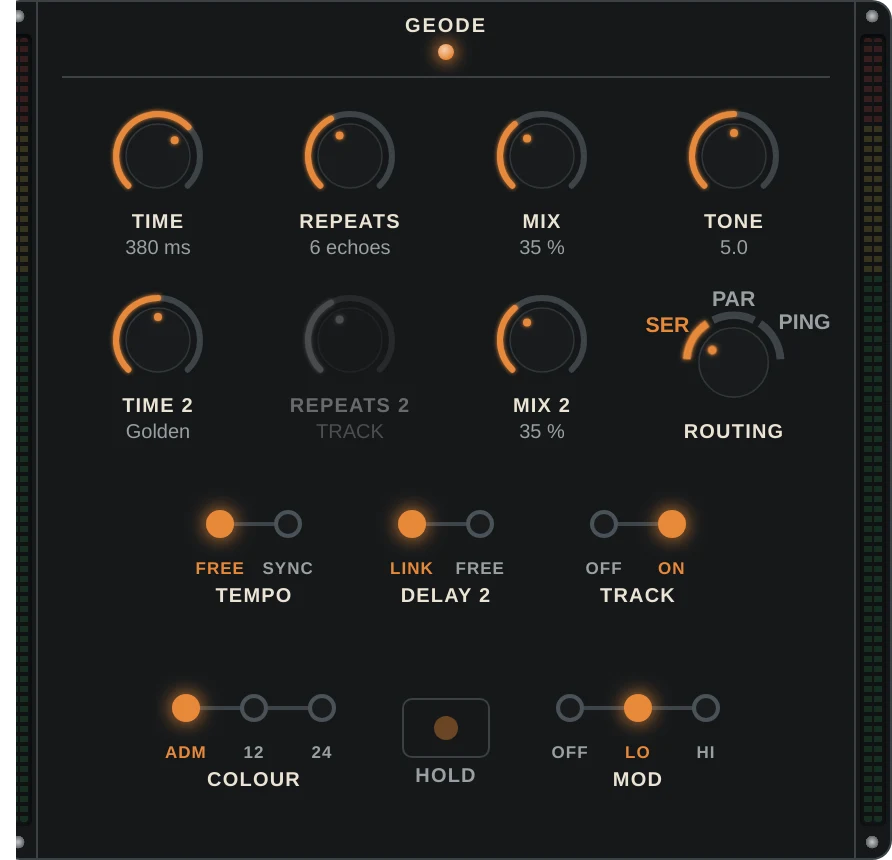
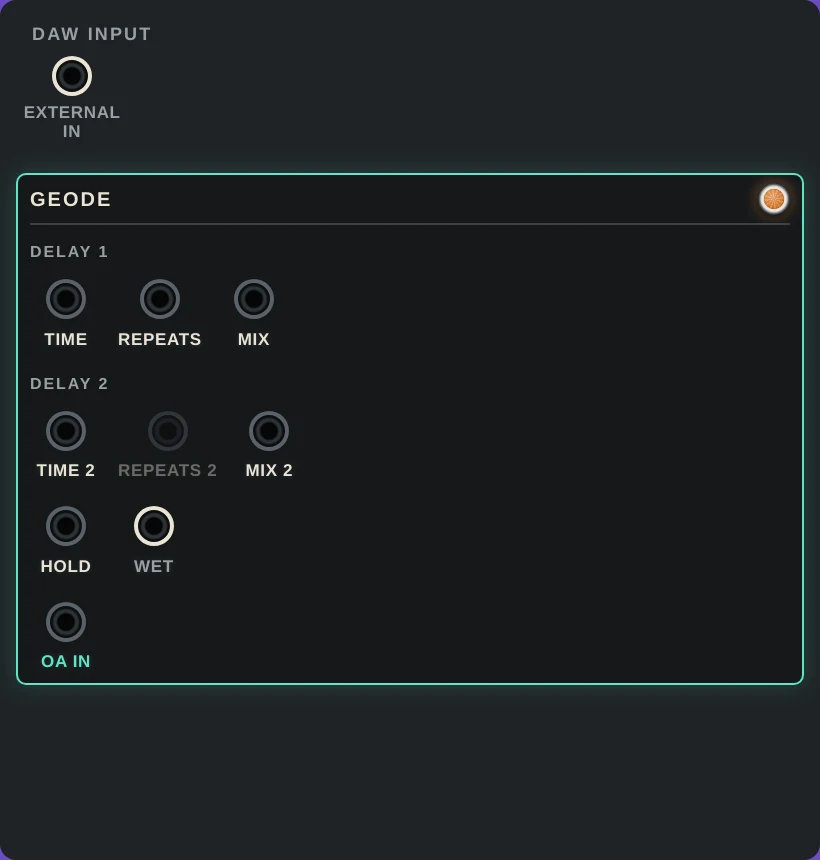
A dual digital delay after the '80s rack delays: two delays, the second a rhythm of the first or its own time.
New
Run two delays, the second a rhythm of the first
On Link, delay 2 takes delay 1's time times a rhythm you pick: triplet, 1/8, golden, which keeps the two from ever lining up, dotted 1/8 or dotted 1/4. On Free it has a time of its own.
Set the time in milliseconds or lock it to the tempo
Time runs from 20 ms to 1.6 seconds. With Sync on, the same knob steps through note values at the host's tempo.
Choose how the two delays are used
Series feeds delay 2 into delay 1, like two pedals in a row. Parallel sends the left input through delay 1 and the right through delay 2. Ping-Pong folds the input to one source and bounces the repeats left and right.
Pick the generation of digital
Colour is ADM, the early '80s, limited to about 6 kHz so a loud, bright repeat dulls and grits. 12-bit, the mid '80s, reaches about 11 kHz, and 24/96 is clean and full range.
Shape the repeats
Tone filters inside the loop, so each repeat is filtered more than the last: a high cut turned left, a low cut turned right. Mod sways the pitch of the repeats, off, light or deep.
Freeze what is repeating
Hold takes in no new sound, and each delay repeats what it holds at a steady level until you let go.
Turn it with the keyboard, in your DAW too
Tab turns the pedal between Front and Back, and Shift+Tab turns it the other way. Option+F and Option+B go straight there.
Keep the dry whole, and set the level back
Advanced in the title menu flips the tile to Dry and Make-up. Dry is Keep, the default, where the dry stays at full and Mix only brings the repeats in, as a pedal in line does, or Fade, where Mix crossfades the dry out without the level rising or falling on the way and at 100% it is the repeats alone, for a Split lane or a return track. Make-up is -12 to +12 dB on Out, after the mix; 0 dB is the sound as before.